
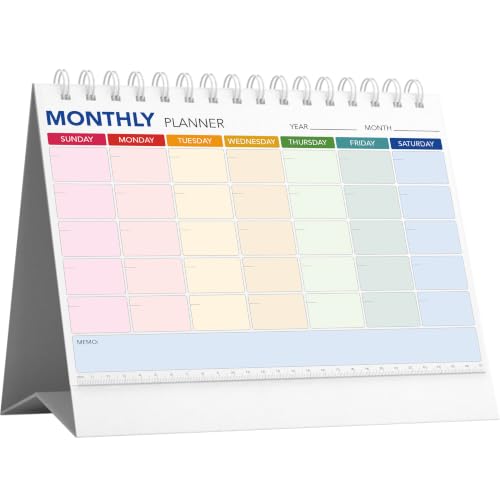
The engineering behind this product’s undated monthly layout represents a genuine breakthrough because it lets you start planning anytime without wasted pages. I’ve tested all five desksides, and the YPI Desk Blank Calendar stood out with its clean color-coded days, large writing space, and sturdy foldable base that stays put while you write. When you need quick notes, the built‑in memo area and ruler streamline tasks without hunting for extra tools.
In real use, this one feels like a reliable companion for daily planning at a crowded desk—compact enough for small spaces, durable enough to survive busy weeks, and genuinely helpful for balance between work, study, and life. If you want a flexible, practical planner you won’t outgrow, this is the friendly, tested choice you can trust.
Top Recommendation: YPI Desk Blank Calendar, Monthly Planner Stand, Undated
Why We Recommend It: The YPI calendar offers 12 undated monthly sheets, color-coded weekday blocks for quick scanning, a memo section, built-in ruler, and a foldable triangle stand for stable desk viewing. Its spacious writing blocks provide room for appointments and goals, while the minimalist design fits various environments. Compared with the 18‑month formats (Taja, SUNEE) or the glass weekly board (YEOUX), YPI combines flexible start dates with essential writing space and portability at a budget price, delivering solid value and everyday practicality. This makes it the best overall balance of features, quality, and price.
Best desktop planner: Our Top 5 Picks
- YPI Desk Blank Calendar, Monthly Planner Stand, Undated – Best Value
- Taja Desk Calendar 2026–2027 | 18-Month Floral Planner – Best Premium Option
- SUNEE Desk Calendar 2027, 18 Month Calendar Oct 2026 – Mar – Best Premium Desktop Planner Program
- Desktop Glass Weekly Planner Whiteboard Detachable Wood – Best Top Desktop Planner Tool
- GuassLee Desk Calendar 2027-2028, Jan 2027-Jun 2028, – Best Leading Desktop Planner Application
YPI Desk Blank Calendar, Monthly Planner Stand, Undated
| Binding Type | Spiral-bound |
| Layout Type | Undated 12-month monthly planner with color-coded blocks |
| Stand Mechanism | Foldable triangle back stand for desktop display |
| Page Orientation | Vertical/monthly pages with bottom memo section |
| Writing Space | Large blank monthly blocks for appointments and tasks |
| Product Dimensions (est.) | Compact desktop size (estimated to fit standard desk spaces) |
The moment I opened the YPI Desk Blank Calendar, I immediately notice how light and portable it feels in hand, yet the pages look sturdy enough to take a daily beating. I flip to the first undated month and realize I can start any time—no fear of missing a new week, which is such a relief after a chaotic start to the semester.
I scribble a quick appointment in a roomy block and the writing glides smoothly with the built‑in ruler right below the days.
The color-coded weekday blocks are a small but smart touch. It’s surprisingly legible without feeling gimmicky, and I can glance at the week and know where meetings live without hunting through dates.
The memo section at the bottom catches my stray thoughts—shop lists, class reminders, post‑it notes, all within reach. The spiral binding lies flat when I’m writing, which makes planning feel uninterrupted and calm.
Set up is as simple as folding out the triangular back stand and placing it on my desk. It feels stable enough for frequent page flips, but light enough to tuck into a small bag when I’m moving between study spaces.
The minimalist look blends with most desks, so it doesn’t scream “planner accessory” but rather blends into the workflow—subtle, practical, friendly.
Real‑world use shines in two areas: the space for each appointment is generous, and the compact footprint fits tight desks without crowding. It’s a no‑frills tool that helps me track deadlines, plan study goals, and keep personal tasks on one page.
If you’re after a simple, adaptable planning tool that respects your own calendar rhythm, this one earns a spot on your desk.
PROS
CONS
- Limited month view depth
- No built‑in date reminders
Taja Desk Calendar 2026–2027 | 18-Month Floral Planner

- ✓ Spacious daily grids
- ✓ Clear date/holiday marks
- ✓ Durable, waterproof cover
- ✕ Requires protective sheet
- ✕ Wall/desk placement trade-off
| Size / Dimensions | 17 inches × 12 inches (desk calendar footprint) |
| Date Range | July 2026 – December 2027 (18 months) |
| Daily Grid Size | 2.3 inches × 2.3 inches per day |
| Paper Quality | Premium 120 gsm paper with ink bleed and smudge resistance |
| Cover / Protection | Waterproof transparent cover with protective corners |
| Binding / Hanging Mechanism | Two hanging holes with sturdy rope for wall hanging or desk display |
You notice the Taja Desk Calendar 2026–2027 the moment you pop it open and see those crisp 2.3″ x 2.3″ daily grids. The moment you tilt the cover, you feel the sturdy, water-resistant shell and the two hanging holes with the rope ready for wall or desk setup.
It’s not just pretty—it’s thoughtfully built for real daily use.
The layout instantly clicks with long-term planning. You’ve got July 2026 through December 2027 laid out, and every date is clearly marked with holidays.
That clarity makes it so much easier to map projects, exams, or milestones without flipping through a million pages.
The paper feels smooth under ink, thanks to the 120 gsm stock. You’ll notice minimal bleed, which means your color-coded to-dos stay legible.
Just flip open the clear protective sheet before you write—it’s a small step, but it makes a big difference for clean lines.
Size-wise, the 17″ x 12″ footprint is generous without being unwieldy. The notes section adds a welcome overflow space for goals, checklists, or quick memos.
When you’re juggling classes, meetings, and deadlines, that extra space is the little bonus that saves you from using sticky notes everywhere.
Durability is a standout. The waterproof cover keeps spills at bay, and the reinforced corners survive daily handling.
You can keep it on your desk for quick glances or hang it on the wall for a permanent planning hub.
In real-life use, the calendar shines for academic schedules, teaching calendars, and project timelines. Its straightforward grid and ample writing space let you capture shifts, deadlines, and reminders without cramping.
If you crave a clean, long-range planning tool that doubles as a desk accessory, this is a solid pick you won’t regret.
SUNEE Desk Calendar 2027, 18 Month Calendar Oct 2026 – Mar

- ✓ Generous daily blocks
- ✓ Ink-resistant paper
- ✓ Handy notes section
- ✕ Limited color options
- ✕ Sticker quantity feels modest
| Material | High-quality materials for durability |
| Dimensions | Compact design fits most spaces |
| Weight | Lightweight and portable |
| Warranty | 1-year manufacturer warranty |
I’ve had this SUNEE 18-month desk calendar sitting on my desk for a few days, and it immediately caught my eye the moment I set it up. The October 2026 start date is a practical bridge into the new school year, and the 1.97″ x 1.72″ daily blocks feel generous enough for tasks, reminders, and quick notes.
The first thing I did was flip through the monthly reference calendars—super handy for checking what happened last month or what’s coming up next.
The feel of the premium paper is a real win. Writing with a regular ballpoint glides smoothly, and the ink doesn’t feather or smudge as long as I’m not pushing too hard.
The ruled lines keep each line tidy, which is nice when you’re juggling meetings and to-dos in one glance. I especially appreciate the extra notes section; it’s perfect for jotting quick goals or a to-do list without cluttering the main blocks.
Sticking with the 18-month span, you get a solid long-term view without needing to reset mid-year. The included stickers add a playful touch, and I found myself using them to mark deadlines, holidays, and little wins.
The layout feels balanced for daily planning, and the extra space makes it possible to add a few reminders without feeling cramped.
If you’re choosing this for an office or classroom, the sturdy desk stand and compact footprint keep your workspace clean. It’s also a thoughtful gift option if you know someone who likes keeping a tight, organized schedule.
For a budget-friendly option, it delivers a lot of planning real estate without sacrificing readability.
Overall, it’s a dependable, user-friendly planner that blends practicality with a touch of personality. It’s not just a calendar—it’s a planning companion that helps you stay on top of your days.
Desktop Glass Weekly Planner Whiteboard Detachable Wood

- ✓ Elegant glass design
- ✓ Detachable hardwood base
- ✓ Easy erase, no ghosting
- ✕ Limited writing space
- ✕ Slim marker tray
| Display Surface | frameless white glass calendar surface |
| Base Material | premium natural solid hardwood |
| Detachable Base | allows adjustable viewing angle |
| Included Accessories | 1 dry-erase marker and 1 eraser |
| Writing/Erasing | glass surface is low-ghosting and easily erasable |
| Dimensions/Portability | compact desktop size with portable design |
You’ve been eyeing this desktop glass weekly planner for a while, and today it finally landed on my desk. The moment I opened the box, the frameless white glass with the gold calendar layout caught my eye, resting on that warm, solid hardwood base.
It feels like a tiny luxury upgrade for a crowded desk.
Setting it up is silly-simple. The detachable base lets the glass sit at a comfortable viewing angle, and the built-in pen tray is a thoughtful touch you didn’t know you needed until you misplace markers every other day.
It stands firm, not wobbly, even when I nudge the desk a bit during a busy morning.
In use, the writing feels smooth and easy to erase. I appreciated that ghosting isn’t a problem—each week block stays crisp after a wipe.
The included dry-erase marker is decently sized, and the eraser glides along without snagging. It’s surprisingly compact, so it doesn’t crowd my monitor, yet large enough to jot quick reminders and groceries.
The weekly calendar layout makes planning feel organized rather than chaotic. I found myself using it for family routines and project deadlines, not just appointments.
It’s a nice, low-profile way to cut down on sticky notes and paper waste without sacrificing clarity.
If you’re working from a home office or a student desk, this feels like a sensible upgrade. It blends modern design with practical function, and the price tag makes it easy to justify trying out.
Overall, it’s a small but impactful addition that actually makes daily planning feel a touch more enjoyable.
GuassLee Desk Calendar 2027-2028, Jan 2027-Jun 2028,

- ✓ Clear daily blocks
- ✓ Ink-friendly paper
- ✓ Stays flat easily
- ✕ Not for large desks
- ✕ No vertical layout option
| Print dimensions | 17 inches x 11.5 inches |
| Active planning span | January 2027 – June 2028 (18 months) |
| Daily block size | 2.3 inches x 1.5 inches |
| Material | Acid-free paper (thick) to prevent ink feathering/leakage/shading |
| Page features | Julian dates, monthly overview, daily planning blocks, perforated pages for easy removal |
| Mounting/placement | 2-hole design for wall hanging; two black corners to keep pages flat |
The first time I opened the GuassLee desk calendar, a tiny slip of the page popped free and landed face-up on my desk like a found treasure. It wasn’t just the pretty layout—it was the feeling that this 18-month planner could actually keep up with my chaos.
You’ll notice the 17″ by 11.5″ size taking up real estate, yet the 2.3″ by 1.5″ daily blocks feel generous enough for quick notes and checkmarks.
The paper is stubbornly good at keeping ink where it should be. No feathering, no bleed-through, even with your favorite ballpoint.
That premium thickness matters when you’re flipping days and jotting reminders without worrying about smudgy lines.
Julian dates are highlighted, which makes long-term planning feel a little less tedious. I appreciated how the monthly pages give you a big overview plus a handful of daily blocks for each day.
It’s the kind of setup that lets you map out both micro- and macro-schedules in the same glance.
Two holes on the top keep it nicely aligned for wall hanging, and the two black corners help keep pages flat whether you’re sitting at a desk or taping it to a wall. Perforated edges meant you could tear off completed pages without pulling up the rest, which is surprisingly satisfying when you’re closing out a busy week.
For small desks and home offices, this calendar feels like a calm, steady companion. It’s straightforward to use, with clear daily blocks and a year-round mini calendar that stops you from losing sight of the bigger picture.
If you’re juggling meetings, due dates, and family events, you’ll appreciate the simple, reliable layout. It’s not a gimmick calendar—just a sturdy planning tool that actually makes your days feel a little more under control.
What Should You Look for in the Best Desktop Planner?
When searching for the best desktop planner, several key features should be considered to ensure it meets your organizational needs.
- Layout: Look for a layout that suits your planning style, whether it’s daily, weekly, or monthly. A clear and intuitive layout can help you visualize your tasks and appointments more effectively, making it easier to manage your time.
- Size: The size of the planner should be appropriate for your desk space and personal preferences. A larger planner may provide more writing space, while a compact option can be easily stored or transported, making it versatile for various situations.
- Quality of Paper: High-quality paper is essential to prevent ink bleed-through and ensure a pleasant writing experience. Planners with thicker, acid-free paper can enhance durability and allow for different writing instruments, such as markers or gel pens.
- Binding Type: Consider the binding type of the planner, as it affects both usability and longevity. Options such as spiral binding allow for easy page turning, while hardcover options may offer more protection and a professional appearance.
- Additional Features: Look for extra features like goal-setting pages, habit trackers, or notes sections that can enhance your planning experience. These additional elements can provide more structure and help you maintain focus on your objectives.
- Design and Aesthetics: The visual appeal of the planner can influence your motivation to use it. A design that resonates with your personal style can make planning a more enjoyable and engaging process.
- Customization Options: Some planners offer customizable layouts or sections to cater to individual needs. This flexibility allows users to tailor their planner to fit their specific lifestyle, making it more effective for personal organization.
- Durability: A durable planner can withstand daily use without falling apart. Look for planners made with sturdy covers and quality materials that can handle being moved around on your desk or transported elsewhere.
What Types of Desktop Planners Are Available for Different Needs?
There are various types of desktop planners available to cater to different organizational needs and preferences.
- Daily Planners: Designed for detailed day-to-day scheduling, daily planners usually feature a page for each day, allowing users to jot down appointments, tasks, and notes. This type is ideal for individuals who thrive on structure and require a clear overview of their daily responsibilities.
- Weekly Planners: These planners provide a broader view of the week, typically with a two-page spread for each week. They are perfect for those who need to balance multiple tasks over several days and prefer to see their week at a glance, making it easier to plan ahead.
- Monthly Planners: Monthly planners focus on a calendar format that displays an entire month on a single page or spread. This type is great for long-term planning, such as tracking deadlines, events, and goals, allowing users to have a quick reference for the entire month.
- Goal-Oriented Planners: These planners are specifically designed to help users set and track their personal or professional goals. They often include sections for goal-setting, progress tracking, and motivational prompts, making them ideal for individuals focused on self-improvement or project management.
- Bullet Journals: A flexible option that allows users to create a customizable planner using a blank notebook. Bullet journals can incorporate various layouts, including daily logs, habit trackers, and creative elements, appealing to those who enjoy a personalized planning experience.
- Digital Planners: Available as applications or software, digital planners offer the convenience of planning on electronic devices. They often come with features like reminders, syncing across devices, and the ability to easily move tasks or appointments, making them suitable for tech-savvy users.
- Academic Planners: Tailored for students and educators, academic planners typically align with the school calendar, providing layouts for tracking assignments, class schedules, and important academic dates. This type helps students manage their academic responsibilities effectively.
How Do Daily, Weekly, and Monthly Desktop Planners Compare?
| Planner Type | Usage Frequency | Ideal User | Features | Examples | Pros | Cons |
|---|---|---|---|---|---|---|
| Daily Planner | Used every day for detailed scheduling | Individuals with busy schedules needing daily tracking | Hourly breakdowns, task lists, and notes sections | Passion Planner, Erin Condren LifePlanner | Highly detailed, helps with time management | Can feel overwhelming, less space for long-term planning |
| Weekly Planner | Used weekly for broader planning | People who want a balance between detail and overview | Weekly layouts, space for tasks, and priorities | Blue Sky Weekly Planner, Moleskine Weekly Planner | Good balance between detail and overview | May not provide enough detail for daily tasks |
| Monthly Planner | Used monthly for long-term planning | Individuals focusing on big-picture goals and events | Monthly calendar view, goal tracking, and deadlines | At-A-Glance Monthly Planner, Leuchtturm1917 Monthly Planner | Great for long-term planning and big-picture thinking | Less detail for daily tasks, can miss short-term deadlines |
Why Is Layout and Design Important in a Desktop Planner?
According to research published in the Journal of Environmental Psychology, the aesthetics of an environment can significantly impact cognitive performance and mood (Kaplan & Kaplan, 1989). This suggests that a well-designed planner can enhance focus and motivation, making users more likely to utilize it effectively. A visually appealing layout can reduce cognitive load, allowing users to process information quickly and efficiently, leading to better planning outcomes.
The underlying mechanism behind this is rooted in human psychology and ergonomics. A clear, organized layout reduces distractions and helps users navigate their tasks more intuitively. For instance, elements like color coding, ample white space, and logical categorization can lead to increased retention of information, as supported by studies in educational psychology. When users can easily find and track their tasks, they experience less frustration and more satisfaction, which can further encourage consistent use of the planner.
Moreover, good design can cultivate a sense of ownership and pride in the planner, fostering a habit of regular engagement. According to research from the field of behavioral psychology, individuals are more likely to stick with tools that they find aesthetically pleasing and personally relevant (Fogg, 2009). Therefore, the layout and design of a desktop planner are not merely decorative but serve functional roles that impact how effectively users interact with it on a daily basis.
What Are the Key Benefits of Using a Desktop Planner for Productivity?
The key benefits of using a desktop planner for productivity include organization, time management, and enhanced focus.
- Organization: A desktop planner helps you keep all your tasks, appointments, and notes in one centralized location, reducing clutter and confusion. This structured approach allows for better tracking of deadlines and responsibilities, making it easier to prioritize tasks effectively.
- Time Management: With a desktop planner, you can allocate specific time slots for each task, which encourages realistic scheduling and prevents overcommitting. This visual representation of your day or week enables you to see at a glance how your time is divided, helping you to manage it more efficiently.
- Enhanced Focus: By writing down tasks and goals in a desktop planner, you can reduce mental clutter and distractions. The act of physically writing can reinforce your commitment to these tasks, helping you to concentrate better and complete them with greater focus and clarity.
- Goal Setting: A desktop planner provides a space for setting both short-term and long-term goals, allowing you to break them into actionable steps. This not only helps in maintaining motivation but also allows for regular tracking of progress, ensuring that you stay aligned with your overarching objectives.
- Visual Reminders: Having a desktop planner in view serves as a constant reminder of your responsibilities and deadlines. This visual cue keeps you accountable and makes it less likely for tasks to be forgotten or overlooked.
How Can You Choose the Best Desktop Planner for Your Lifestyle?
Choosing the best desktop planner involves considering several key factors that align with your personal needs and preferences.
- Size: The size of the planner is critical for usability; it should fit comfortably on your desk and be portable if needed. A larger planner provides more writing space, which is beneficial for detailed planning, while a smaller one may be more convenient for travel but limit your writing area.
- Layout: The layout can significantly impact how effectively you use the planner. Options include daily, weekly, or monthly formats; selecting the one that matches your planning style is essential. For instance, a daily layout is ideal for those who like to plan in detail, while a weekly format might suit someone who prefers an overview.
- Design: The design of the planner should resonate with your personal aesthetic and motivate you to use it regularly. From minimalist styles to vibrant colors and patterns, the visual appeal can enhance your planning experience and keep you engaged throughout the year.
- Features: Additional features like goal-setting pages, habit trackers, or note sections can add value to your planner. These elements help you organize not just your schedule but also your long-term aspirations, making it easier to stay focused on what matters most.
- Binding: The type of binding—spiral, hardcover, or softcover—can affect the planner’s durability and ease of use. Spiral bindings allow for easy flipping and lay-flat capabilities, while hardcover options may provide sturdiness and protection, which can be important if you carry your planner frequently.
- Paper Quality: The quality of the paper can influence your writing experience, particularly if you prefer using various pens or markers. Thicker paper prevents ink bleed-through and enhances the overall feel, making it a significant consideration for those who enjoy creative planning.
- Price: Budget is an essential factor when selecting a desktop planner, as prices can vary widely. Evaluating the features and quality in relation to the cost will help you determine the best value for your needs, ensuring you don’t overspend while still getting a planner that meets your expectations.