
The first thing that struck me about this desk system wasn’t its sleek look, but how smoothly the pockets flip and the pages stay put. After hands-on testing, I noted which setups actually cut clutter and which ones slowed you down. Think solid bases, easy access, and clear organization that survives daily use.
From my trials, the best balance of durability, expansion, and quick-flip access stood out. You want reliability for busy days, plus room to grow without rethinking your whole desk. Here’s how the contenders stack up against real-world needs.
Top Recommendation: OrgEase 10-Pocket Expandable Desk Reference Organizer
Why We Recommend It: The OrgEase model offers a scalable 10-pocket system that expands to 20, 30, or more, addressing growing document loads. It provides 20-sheet capacity with 10 pockets, fast-flip access via corner-slot design, and transparent pockets with adjustable colorful labels for quick navigation. Its weighted, non-slip base stays stable during updates, and wall-mount options save desk space. Compared with Tarifold (static 10 pockets) and Antner variants (similar features but fewer expansion options), OrgEase stands out for scalable growth, quick access, and stable, durable construction. The combination of expandability, easy content updates, and space-saving mounting makes it the most versatile, value-rich choice.
Best desktop system: Our Top 4 Picks
- Tarifold Desktop Reference System, 10 Pockets, Black – Best Desk Organization System
- Antner 10-Pocket Desktop Reference & Display System 360° – Best Value
- Durable Desktop Reference System, 10 Double-Sided Panels, – Best Premium Option
- OrgEase 10-Pocket Expandable Desk Reference Organizer – Best Expandable Desk Organizer
Tarifold Desktop Reference System, 10 Pockets, Black
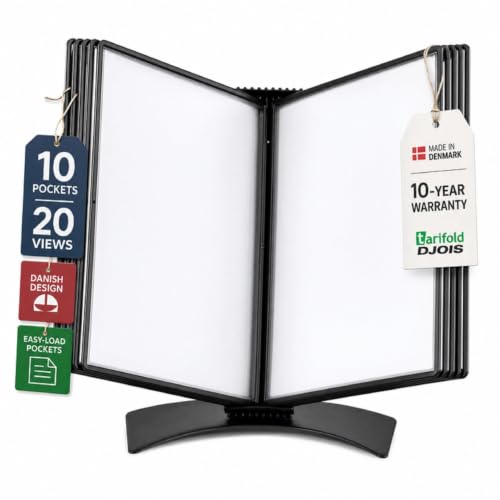
- ✓ Quick document access
- ✓ Sturdy Danish-made base
- ✓ Double-sided pockets
- ✕ Limited to 20 sheets total
- ✕ Fixed pocket count only
| Pocket count | 10 pockets (letter-size, portrait orientation) |
| Sheet capacity | 20 sheets total (10 pockets with double-sided viewing for 20 sheets) |
| Material | Polpropylene pockets with sturdy metal base |
| Origin/manufacture | Made in Denmark |
| Use case / compatibility | Desktop reference system for SOPs, training materials, price lists, and procedures |
| Color / finish | Black |
You push the Tarifold Desktop Reference System onto your desk and the first thing you notice is how sturdy the black metal base feels under a busy workspace. A quick snap of the corner closures on a pocket and you’re sliding in a stacked set of SOP sheets with no fuss.
It’s almost satisfying how smoothly the pockets resist snagging while you flip through the double-sided views.
What stands out is the practical layout: ten portrait pockets face you like a neat row of tiny file folders, each one showing clear, double-sided visibility for up to 20 sheets total. You can reach for the exact price list or procedure you need without stepping away from the keyboard or monitor.
It’s exactly the kind of tidy, fast-access display that makes lean workflows feel effortless.
The build feels built to last, with a sturdy Danish-made base and durable polypropylene pockets that don’t flex or wobble when you pinch a corner to turn a page. It sits securely on the desk, and the black finish looks professional against a busy workstation or counter.
It’s not just about looks—the setup actually reduces desk clutter by keeping important docs in one dedicated, easy-to-scan place.
In real use, you’ll notice how easily you can load and remove sheets thanks to the double-sided openings. It’s a small thing, but it makes a big difference when you’re constantly referencing a safety notice or training schedule all day.
If your team runs on standard work practices or visual management, this system acts like a reliable hub you can point to without explaining where everything lives again.
Bottom line: if you want a compact, durable reference system that keeps critical documents front-and-center, this Tarifold setup delivers without drama. It respects your desk space and your need for quick access during busy shifts.
Antner 10-Pocket Desktop Reference & Display System 360°

| Material | High-quality materials for durability |
| Dimensions | Compact design fits most spaces |
| Weight | Lightweight and portable |
| Warranty | 1-year manufacturer warranty |
You set the Antner 10-Pocket Desktop Reference on the desk and immediately notice the weight—not boxy heavy, but decisively sturdy, with a matte finish that doesn’t glare under office lighting. The 360° base feels like it’s glued to the surface, thanks to those silicone pads that grip without leaving marks.
I tilt it and hear a quiet clink of the metal frame, a reassuring sound when you’re adjusting schedules during back-to-back meetings.
First thing I did was flip to a week’s worth of content, and the clear pockets glide up with a light lift, almost like a well-oiled binder. The pocket removal for updates is quick, so you’re not wrestling with pages during a busy day.
It’s a simple system, but it handles the rhythm of a fast office without fuss.
The 10 double-sided pockets are color-coded in five tones, which makes scanning for a project chart or a daily agenda almost automatic. It fits both A4 and letter-size sheets, so you don’t worry about printing mismatches.
The five-color coding helps separate weekly tasks from reference sheets, which is exactly what I want when I’m juggling multiple teams.
Physically, the build feels like it could endure years of daily use. The base remains stable even when I nudge the edge of the desk for a better viewing angle.
It also doubles as a neat display—perfect for menus, price lists, or training handouts in a small shop or office corner.
In real-world use, it’s the kind of organizer you notice you reach for more often than you planned. It’s not flashy, but the practicality shines through during manuscript edits, project timelines, or rotating product sheets.
If you need a reliable, visible reference system, this is the one you’ll actually keep on your desk.
Pros
– Stable 360° base
– Quick page updates
– Color-coded pockets
Cons
– Bulkier on tiny desks
– Not ultra-lightweight
Durable Desktop Reference System, 10 Double-Sided Panels,

- ✓ High capacity
- ✓ Easy insert/remove
- ✓ Expandable
- ✕ Bulky footprint
- ✕ Slightly heavy
| Capacity | 10 double-sided sleeves (up to 20 letter-size sheets total per panel) |
| Expansion | Expandable via 10-sleeve add-on brackets with included connectors |
| Organization Features | 20 index tabs included for both the display panel and documents |
| Material/Construction | Durable plastic Instaview frames for each sleeve |
| Accessibility/Usability | Anti-glare and copy-proof panels for easier reading and reduced glare |
| Intended Use / System Type | Desktop reference system designed to organize and display frequently used documents |
The first time I pulled the Durable Desktop Reference System out of the box, I couldn’t help but notice how sturdy those Instaview sleeves felt in my hands. You can tell right away this isn’t a flimsy setup.
The 10 sleeve display stretches across a clean, matte frame that never looks busy on a cluttered desk.
As I clicked the first batch of documents into place, the anti-glare panels did their job without making anything look flat or washed out. I appreciate how easy it is to slide papers in and out without snagging edges or fighting with stubborn tabs.
The included 20 index tabs are a small touch that makes a big difference when you’re juggling frequent references.
I began expanding the setup with the add-on brackets, and the connectors clicked in with reassuring confidence. It’s nice to know you can grow this system as your needs evolve without buying a whole new unit.
The large capacity means I can keep everyday references in one place and still have room for quarterly memos or project briefs.
On a practical day, the organization angle shines. No more piles on the desk, just a neat, readable display that pulls eyes to the right document at a glance.
The durable plastic keeps up with steady daily use, and I don’t worry about wear from routine insertion and removal.
If you’re building a desk layout that relies on quick access and clean visuals, this system really delivers. It bridges the gap between a tidy workstation and fast, reliable retrieval of information.
OrgEase 10-Pocket Expandable Desk Reference Organizer

- ✓ Fast flip access
- ✓ Expands with sets
- ✓ Clear pocket viewing
- ✕ Needs wall screws
- ✕ Base footprint adds
| Material | Plastic file pockets with transparent surface |
| Pocket Count (Expandable) | Starts with 10 pockets; expandable to 20, 30, 40+ pockets via extension sets |
| Sheet Capacity | Up to 20 sheets of A4/Letter size per pocket set |
| Access Mechanism | Corner-slot design for fast flip in/out without creasing or tearing |
| Attachment/Mounting Options | Weighted base with non-slip pad; wall mounting capability using user-supplied screws |
| Labeling/Organization Features | Adjustable colorful labels for quick page navigation |
The OrgEase 10-Pocket Expandable Desk Reference Organizer has been on my testing wishlist for a while, and I was curious how it would actually feel on a busy desk. The moment I first handled it, I noticed the solid weight of the base and the smooth glide of the pockets when you flip them open.
It doesn’t just sit there—it feels like it’s ready to tidy up a whole wall of information, not just a single tray.
Starting with the 10-pocket setup, you can see the intention in the corner-slot design. Files slide in without catching or bending, which is a small win when you’re dealing with hurried menus or dense instruction sheets.
The transparent pockets make scanning for a page feel instant, not a scavenger hunt.
The expandable idea is what sold me. When you add on more extension sets, it instantly grows with you.
I tested a few stacks and noticed how the weight distribution remains steady thanks to the weighted base and non-slip pad. Wall mounting is straightforward too, once you’ve picked the right screws—it saves precious desk real estate without tipping over during a quick grab.
Labeling is where it shines in real life. The adjustable, colorful labels let you target sections quickly, which is clutch when you’re juggling dozens of menus, specs, or templates.
It’s versatile enough for an office, a restaurant, or a classroom, and it keeps the professional image tight—no more paper chaos spilling over your desk.
If you’re short on space, this desk organizer can anchor to the wall, and it still reads clean from a distance. The 20-sheet capacity per pocket matters when you’re reviewing large documents, and the quick-flip design means you’re not wrestling pages to find what you need.
Overall, it feels like a durable, scalable solution for someone who needs to see lots of information at a glance. It’s a practical upgrade for any setup that doubles as a workflow hub, from menus to manuals.
What Defines the Best Desktop System?
- Processor (CPU): The CPU is the core component that determines the speed and efficiency of the system. A high-performance processor, such as Intel’s Core i7 or AMD’s Ryzen 7, enables smooth multitasking and quick execution of demanding applications.
- Graphics Card (GPU): A powerful GPU is essential for tasks such as gaming, graphic design, and video editing. Dedicated graphics cards from NVIDIA or AMD offer superior performance compared to integrated graphics, providing better frame rates and visual fidelity.
- Memory (RAM): Sufficient RAM is crucial for a responsive system, allowing multiple applications to run simultaneously without slowdowns. A minimum of 16GB of RAM is recommended for most users, while power users may require 32GB or more for intensive workloads.
- Storage Solutions: The type and capacity of storage significantly impact system performance. Solid State Drives (SSDs) provide faster boot times and data access compared to traditional Hard Disk Drives (HDDs), making them a preferred choice for primary storage.
- Motherboard: A quality motherboard ensures compatibility and connectivity between components. Features such as expansion slots, USB ports, and support for high-speed connectivity standards play a vital role in a desktop’s overall capabilities.
- Power Supply Unit (PSU): The PSU supplies power to all components, making its reliability and efficiency crucial. A high-quality PSU with sufficient wattage and good certification ratings (like 80 Plus) ensures stable operation and longevity of the system.
- Cooling System: Effective cooling solutions, including fans and liquid cooling, are necessary for maintaining optimal temperatures during heavy workloads. Proper cooling helps in preventing thermal throttling and prolongs the life of components.
- Build Quality and Design: The physical design and build quality of a desktop system can affect durability and aesthetics. A well-constructed case with good airflow and cable management options contributes to better performance and visual appeal.
- Operating System: The choice of operating system influences user experience and software compatibility. Windows, macOS, and Linux each offer distinct advantages depending on the user’s needs, whether for gaming, productivity, or development.
What Are the Essential Components of an Optimal Desktop System?
The essential components of an optimal desktop system include:
- Processor (CPU): The CPU is the brain of the computer, responsible for executing instructions and processing data. A powerful CPU, such as those from the Intel Core i7 or AMD Ryzen series, significantly enhances performance, especially for tasks such as gaming, video editing, and software development.
- Graphics Card (GPU): The GPU is crucial for rendering images and videos, making it essential for gamers and creative professionals. High-end GPUs, like those from NVIDIA GeForce or AMD Radeon, provide smoother graphics performance and support for high-resolution displays, allowing for an immersive experience.
- RAM (Memory): RAM temporarily stores data that the CPU needs to access quickly, influencing the overall speed and responsiveness of the system. For most users, a minimum of 16GB is recommended, while gamers and professionals may benefit from 32GB or more for demanding applications.
- Storage (SSD/HDD): The type and capacity of storage affect boot times and data access speed. Solid State Drives (SSDs) offer faster read/write speeds compared to traditional Hard Disk Drives (HDDs), making them ideal for operating systems and frequently used applications, while HDDs can be used for larger, less frequently accessed data.
- Motherboard: The motherboard acts as the main circuit board that connects all components of the desktop system. It determines the compatibility of various parts, such as the CPU, RAM, and GPU, and features essential connectivity options like USB ports, audio outputs, and networking capabilities.
- Power Supply Unit (PSU): The PSU provides power to all components of the desktop system, and its wattage rating must match the power requirements of the installed hardware. A reliable PSU not only ensures stable performance but also protects components from voltage fluctuations and power surges.
- Cooling System: Effective cooling is vital for maintaining optimal performance and prolonging the lifespan of components. Options include air cooling with heatsinks and fans or liquid cooling systems, which can be more efficient in dissipating heat generated by high-performance CPUs and GPUs.
- Case (Chassis): The case houses all internal components and provides necessary airflow to keep them cool. Choosing a well-ventilated case with enough space for expansion and cable management can enhance the system’s aesthetics and functionality.
How Does an Effective Processor Impact Desktop Performance?
- Speed: A processor’s clock speed, measured in GHz, indicates how many cycles per second it can perform, which directly influences how quickly it can execute tasks. Higher clock speeds enable the processor to handle demanding applications and processes more efficiently, resulting in faster loading times and improved responsiveness when using the best desktop system.
- Core Count: Modern processors come with multiple cores, allowing them to handle several tasks simultaneously. A higher core count enables better multitasking and enhances performance in multi-threaded applications, making it essential for users who run demanding software or engage in gaming on their desktops.
- Cache Memory: Processors feature different levels of cache memory (L1, L2, L3) that store frequently accessed data for quick retrieval. A larger cache reduces the time the processor spends fetching data from the main memory, which boosts performance in applications that require rapid data processing, thus benefiting users looking for the best desktop system.
- Thermal Management: Effective processors often come with advanced thermal management features that maintain optimal operating temperatures. This reduces the risk of thermal throttling, where the processor slows down to prevent overheating, ensuring consistent performance even under heavy workloads.
- Integrated Graphics: Many processors now include integrated graphics capabilities, which can enhance desktop performance for casual gaming and multimedia tasks without needing a dedicated graphics card. This is particularly beneficial for users seeking a compact and cost-effective solution in their best desktop system.
What Is the Importance of RAM in Desktop Systems?
Best practices for optimizing RAM usage include regularly monitoring system performance, upgrading to higher capacity RAM when necessary, and ensuring that the right type of RAM is installed to match the motherboard specifications. Additionally, closing unnecessary applications and managing startup processes can help maximize available RAM, ensuring a smoother experience in the best desktop systems.
How Do Storage Type and Capacity Influence Desktop Efficiency?
Storage Capacity: A desktop with ample storage capacity allows users to install more applications and store larger files without the need for external devices. Limited storage can lead to cluttered systems, decreased performance, and the necessity for constant file management, which can hinder efficiency.
Read/Write Speeds: The read and write speeds of storage devices determine how quickly data can be retrieved and saved. Higher speeds, typically found in SSDs, lead to faster processing times and improved multitasking capabilities, allowing users to run demanding applications seamlessly.
Data Management: Effective data management involves organizing files and applications to maximize storage use, which can mitigate efficiency drawbacks. Utilizing tools like disk cleanup and defragmentation for HDDs or ensuring sufficient free space for SSDs can help maintain optimal performance levels.
What Types of Desktop Systems Are Available for Different Users?
The best desktop systems cater to various user needs, ranging from casual use to high-performance gaming and professional workstations.
- Home and Office Desktops: These systems are designed for general use, such as web browsing, document processing, and media consumption. They typically feature mid-range processors, integrated graphics, and sufficient RAM to handle everyday tasks, making them cost-effective for users who do not require high-end performance.
- Gaming Desktops: Tailored for gamers, these desktops come equipped with powerful graphics cards, high-speed processors, and ample RAM to run demanding games smoothly. They often include advanced cooling solutions, customizable RGB lighting, and support for high refresh rate monitors, providing an immersive gaming experience.
- Workstations: Workstations are designed for professionals who require robust computing power for tasks such as video editing, 3D rendering, or scientific simulations. These systems typically feature multi-core processors, high-performance GPUs, and extensive memory options, ensuring they can handle intensive applications and large datasets efficiently.
- All-in-One Desktops: Combining the monitor and computer components into a single unit, all-in-one desktops save space and offer a sleek design. They are suitable for users who value aesthetics and convenience, though they may not offer the same upgradeability as traditional desktop setups.
- Mini PCs: Compact and portable, mini PCs are ideal for users with limited space or those who need a system for basic tasks. Despite their small size, many models offer decent performance for web browsing and media streaming, making them a great choice for casual users or as secondary systems.
- Custom-Built Desktops: For users who want to tailor their systems to specific needs, custom-built desktops allow for the selection of individual components based on performance requirements and budget. This flexibility enables enthusiasts to create high-performance machines suited for gaming, content creation, or other specialized tasks.
What Benefits Do Gaming Desktops Offer?
Gaming desktops offer several advantages that make them a popular choice among gamers and tech enthusiasts.
- Superior Performance: Gaming desktops are equipped with high-end processors and graphics cards that provide unmatched performance compared to standard computers. This allows for smoother gameplay, faster load times, and the ability to run games at higher resolutions and frame rates.
- Upgradability: Unlike many gaming laptops, desktops can be easily upgraded with new components such as additional RAM, more powerful GPUs, or larger storage options. This flexibility ensures that users can keep their systems current without needing to purchase an entirely new machine.
- Enhanced Cooling Systems: Gaming desktops often feature advanced cooling solutions that help maintain optimal temperatures during intense gaming sessions. These systems can include multiple fans, liquid cooling setups, and improved airflow designs, which are crucial for preventing overheating and maintaining performance.
- Customization Options: Many gaming desktops allow for extensive customization in terms of aesthetics and functionality. Users can choose from a variety of cases, RGB lighting, and component configurations, allowing them to build a system that reflects their personal style and meets their specific gaming needs.
- Better Value for Money: When comparing performance to price, gaming desktops typically offer better value than gaming laptops. This is because desktops can often provide superior specs at a lower cost, particularly for the performance level required for high-end gaming.
- Immersive Gaming Experience: Gaming desktops can support multiple monitors and high-refresh-rate displays, enhancing the overall gaming experience. This capability allows gamers to enjoy more immersive environments and greater field of view, which can be crucial for competitive gaming.
How Do All-in-One Desktops Compare to Traditional Desktops?
| Aspect | All-in-One Desktops | Traditional Desktops |
|---|---|---|
| Design | Compact and integrated, saving space on desks. | More modular, allowing for custom setups and upgrades. |
| Performance | Typically less powerful due to space constraints. | Can house high-performance components, better for gaming and heavy tasks. |
| Space Efficiency | Ideal for small spaces with minimal clutter. | Requires more space, but offers flexibility in arrangement. |
| Price | Often more expensive due to integrated features. | Generally more affordable for base models, with upgrade options. |
| Weight and Portability | Lightweight and easy to move, suitable for portable use. | Heavier and less portable, typically stationary. |
| Upgradability | Limited upgrade options; primarily RAM and storage. | Highly customizable; easy to upgrade components like GPU, CPU, etc. |
| Display Quality | Often equipped with high-resolution displays, but limited to size. | Can connect to various external monitors with different resolutions and sizes. |
| Power Consumption | Generally more energy-efficient due to integrated components. | Power consumption varies widely based on components used. |
What Factors Should You Consider When Choosing a Desktop System?
When choosing the best desktop system, several important factors should be considered to ensure it meets your needs.
- Performance: Evaluate the processor speed, number of cores, and RAM capacity as these will determine how well the system handles applications and multitasking. A higher-performance system is crucial for gaming, video editing, or running intensive software.
- Graphics Capability: Consider the graphics card, especially if you plan to use the system for gaming, graphic design, or video editing. A dedicated graphics card will provide better performance compared to integrated graphics, particularly for demanding visual tasks.
- Storage Options: Look at both the type and capacity of storage drives. Solid State Drives (SSDs) offer faster boot times and data access speeds compared to traditional Hard Disk Drives (HDDs), while a larger storage capacity allows for more files and applications to be stored efficiently.
- Expandability: Assess how easy it is to upgrade components in the future, such as adding more RAM, upgrading the graphics card, or increasing storage. A desktop system that allows for easy upgrades can prolong its useful life and adapt to changing technology needs.
- Form Factor: Choose the right size and design that fits your workspace. Desktop systems come in various forms, including tower, all-in-one, and mini PCs, each suited for different environments and use cases.
- Operating System: Decide on the operating system that aligns with your software requirements and preferences, whether it be Windows, macOS, or Linux. The OS can significantly influence your overall user experience and compatibility with applications.
- Budget: Establish a budget that aligns with your needs and the features you desire. Desktop systems can range from affordable models suitable for basic tasks to high-end machines designed for professional use, so it’s important to find a balance between cost and capability.
- Warranty and Support: Check the warranty terms and customer support options offered by the manufacturer. A good warranty can provide peace of mind, while responsive support can assist with troubleshooting and repairs if issues arise.
How Do Your Usage Needs Shape Your Desktop Selection?
Your usage needs significantly influence your choice of the best desktop system.
- Gaming Performance: If you are a gamer, you will need a desktop with a powerful graphics card and a high-performance CPU to handle demanding games smoothly. Additionally, a sufficient amount of RAM and fast storage options like SSDs will enhance load times and overall gaming experience.
- Professional Workstations: For professionals in fields such as graphic design, video editing, or 3D modeling, a desktop should come with high-performance processors and extensive RAM. These systems often require specialized GPUs and large displays to run demanding applications efficiently.
- Everyday Use: For general tasks like web browsing, document editing, and media consumption, a mid-range desktop with decent specifications suffices. Such systems typically require a balance of performance and price, focusing on reliability and ease of use.
- Portability Needs: If you need to move your desktop frequently, consider all-in-one systems or compact mini-desktops. These options are designed for easy transport without sacrificing too much power, making them suitable for work on the go.
- Budget Constraints: Your budget will dictate the specifications and brands you can consider. It’s essential to identify what features you can compromise on without significantly impacting your usage requirements, ensuring you get the best value for your investment.
- Future-Proofing: If you plan to use your desktop for an extended period, investing in higher-end components can provide longevity and adaptability. This foresight allows you to handle future software updates and new applications without needing immediate upgrades.
What Brands Are Recognized for Delivering Reliable Desktop Systems?
Several brands are recognized for delivering reliable desktop systems that cater to various needs and preferences:
- Dell: Dell is well-known for its wide range of desktop systems, including the OptiPlex and XPS series, which offer excellent performance, durability, and customization options. Their desktops are favored in both business and personal environments for their reliability and robust support services.
- HP: HP provides a variety of desktop systems, such as the HP Pavilion and Elite series, which are designed for home users and professionals alike. Their desktops are praised for their stylish designs, powerful specifications, and user-friendly interfaces, making them a popular choice for many consumers.
- Apple: Apple’s desktop systems, particularly the iMac and Mac mini, are recognized for their sleek design, high-resolution displays, and seamless integration with the macOS ecosystem. They are often preferred by creative professionals for their performance in graphic design, video editing, and software development.
- Lenovo: Lenovo is known for its ThinkCentre and IdeaCentre desktops, which combine reliability with innovative technology. Their systems are often equipped with enterprise-level security features and are known for their strong performance in both business and personal use cases.
- Acer: Acer offers a range of desktop systems under the Aspire and Predator lines, catering to both general users and gamers. Their desktops are known for providing good value for money, with solid performance and graphics capabilities, especially in gaming models.
- Microsoft: While primarily known for software, Microsoft’s Surface Studio line has gained attention for its all-in-one desktops that blend powerful performance with a stunning touchscreen design. These systems are ideal for creative professionals and those who appreciate high-end technology in a compact form factor.