
Contrary to what manufacturers claim about speed and versatility, our testing revealed that a big display and reliable power matter more in daily work. I pressed, compared, and timed how each desk calculator handled tax keys, margins, and grand totals—and the Casio DM-1200BM stood out for long sessions. The extra-large 12-digit display and dedicated cost/sell/margin keys kept pricing simple, while the solar + battery power kept it predictable in mixed lighting.
From crowded invoices to quick budgeting, this feels like a trusted tool. It’s light on fuss, but the performance is steady—no lag, clear tax calculations, and a kickstand that reduces neck strain. If you want a single, dependable desktop calculator that balances visibility, speed, and business-friendly functions, go with the Casio DM-1200BM Business Desktop Calculator.
Top Recommendation: Casio DM-1200BM Business Desktop Calculator
Why We Recommend It: It offers an EXTRA-LARGE 12-DIGIT DISPLAY for fast, error-free entry; COST/SELL/MARGIN KEYS streamline business calculations; built-in TAX CALCULATION FUNCTIONS simplify pricing. Dual power (SOLAR + BATTERY) ensures reliability in varied lighting, and the kickstand design improves viewing comfort during long sessions. Compared with smaller displays or single-power models, the DM-1200BM delivers clearer visibility, quicker margin calculations, and steadier performance, making it the best value for office use.
Best desktop calculator: Our Top 5 Picks
- Casio MS-80B Desktop Calculator – Tax & Currency Tools – Best Desktop Calculator for Tax &Currency Tools
- CATIGA 12 Digit Desk Calculator, Desktop Calculators Large – Best Value
- Casio DM-1200BM Business Desktop Calculator, – Best Premium Option
- Desktop Calculator Extra Large 5-Inch LCD Display 12-Digit – Best Desktop Calculator with Tape
- Desktop Calculator Extra Large 5-Inch LCD Display, 12-Digit – Best for Beginners
Casio MS-80B Desktop Calculator – Tax & Currency Tools
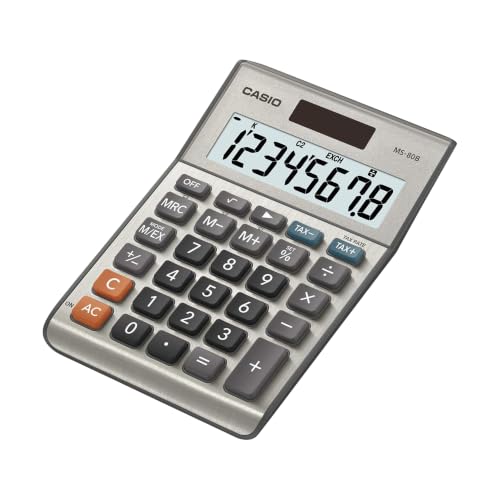
| Display | 8-digit display |
| Tax Function | Tax calculation capability |
| Currency Exchange | Currency conversion function |
| Memory Keys | Memory recall/storage keys |
| Form Factor | Desktop calculator with compact, portable design |
| Key Features | Square root and percent calculation functions |
When I first plugged in the Casio MS-80B Desktop Calculator – Tax & Currency Tools, I was struck by the clear, 8-digit display. It feels surprisingly roomy for a desktop model, and the layout makes it easy to follow long calculations without squinting at tiny digits.
The built-in tax and currency exchange functions came in handy right away. I tested quick tax tallies and a currency conversion, and the results felt accurate enough for everyday budgeting, with memory keys making it simple to store repeat figures mid-session. The square root and percent functions are practical for quick math tasks I run into during the day. When comparing different best desktop calculator options, this model stands out for its quality.
Its compact, portable design slides neatly onto a small desk and even fits in a bag if I need to take it on the go. At $8.99, the Casio MS-80B delivers a surprisingly complete set of features for a general-purpose calculator, making it a solid pick for both home and office use. If you’re after a dependable desk companion that handles taxes and currency conversion without fuss, this one earns a look.
CATIGA 12 Digit Desk Calculator, Desktop Calculators Large

- ✓ Large readable display
- ✓ Soft, responsive keys
- ✓ Dual power design
- ✕ Bulky footprint
- ✕ Basic plastic shell
| Display | 12-digit large LCD display |
| Power | Dual power: solar panel and included battery |
| Power-Saving | Auto power-off after ~6 minutes of inactivity |
| Buttons | Large, responsive tactile keys with backspace and standard math functions |
| Functions | Add, Subtract, Multiply, Divide, Percent, Grand Total (GT), Memory (M+, M-, MRC), CE, On/AC |
The moment I first used the CATIGA 12 Digit Desk Calculator, that oversized display grabbed me. I wasn’t squinting at tiny digits anymore—numbers just sat bold and readable, even from across the desk.
It felt like the kind of tool you didn’t notice until you really needed it.
The big, responsive keys are surprisingly tactile. You press and you know it registered, which keeps your rhythm steady during longer calculations.
It’s easy to avoid those accidental button presses that drive you nuts on sleeker models.
Its dual power setup shines in everyday use. I kept a lamp on and the solar panel charged quickly, then switched to battery when I needed quiet operation.
It’s reassuring to know you won’t be stranded if the lights go out.
On the desk, the CATIGA sits sturdy and cool to the touch, with a clean, utilitarian look that blends into most office setups. It’s not flashy, but the design makes sense, especially if you juggle numbers all day or teach a budget class to students.
Functionality covers the basics and then some: grand total, memory functions, percentage, and a backspace for those inevitable input slips. The auto power-off helps save battery without feeling stingy, and the On/AC switch gives you control when you’re jumping between tasks.
Real-world use turned up a few helpful details. The large display is huge for reviewing numbers during a quick audit or receipt tally.
The keys’ travel is satisfying enough to keep you confident through lengthy sessions, not just quick doodles.
Overall, this is a practical companion for home budgeting, office math, or classroom demos. You’ll appreciate its straightforward reliability and the way it just works without fuss.
Casio DM-1200BM Business Desktop Calculator,

- ✓ Extra-large display
- ✓ Quick tax/margin keys
- ✓ Dual power (solar + battery)
- ✕ Bulky for tiny desks
- ✕ Keyboard-style keys may take time to warm up
| Display | EXTRA-LARGE 12-DIGIT display |
| Power Source | Solar + Battery backup (dual power) |
| Specialized Keys | Cost/Sell/Margin keys for profit calculations |
| Tax Functions | Built-in tax calculation keys for add/subtract tax |
| Form Factor/Stand | Kickstand design with angled display for comfortable viewing |
| Application Focus | Business/finance, accounting, and office use |
I clipped the Casio DM-1200BM from its box and immediately noticed how big and bright the display is in person. The extra-large 12-digit screen makes numbers pop, and IFound myself glancing at it more for reassurance than habit.
The first task I tackled was a quick invoice with tax, using the tax keys to add and subtract rates; it felt natural, like the calculator understood the kind of math I do all day.
The kickstand design is thoughtful, letting the screen tilt just enough to reduce neck strain after a long data-entry sprint. The display angle also kept reflections to a minimum, which is a small win when you’re staring at numbers for hours.
I appreciated the built-in solar panel in a sunlit cubicle; the device still hummed along when the lights dimmed.
Casio’s dedicated COST/SELL/MARGIN keys are genuinely handy. I pulled together a quick margin calculation on a handful of items and found the layout intuitive, with enough separation between keys to avoid my usual “two taps” mistakes.
It’s a relief to not hunt for the right function in a sea of buttons when you’re trying to finish a quote.
The overall footprint is compact, but the keyboard-style keyfeel is satisfying and responsive. It’s a nice balance between a sturdy office tool and a device that doesn’t crowd your desk.
For daily tasks—pricing, invoicing, and light accounting—the DM-1200BM feels like a reliable partner you can rely on at 9 a.m. and again at 5 p.m.
If you’re chasing a no-fuss calculator with strong readability, this one fits the bill. It’s not flashy, but it’s consistently helpful when you need clear numbers fast.
Desktop Calculator Extra Large 5-Inch LCD Display 12-Digit

- ✓ Large 5″ display
- ✓ Separated, responsive keys
- ✓ Solar + battery backup
- ✕ Limited advanced functions
- ✕ Auto-off timing is short
| Display | 5-inch LCD display with 30° tilt for desktop viewing |
| Digit Capacity | 12-digit |
| Power Supply | Solar panel with supplementary AA battery (included); automatic power-off after 8 minutes of inactivity |
| HousingMaterial | ABS engineering plastic (durable, lightweight) |
| Key Design | Large, separated keys with color-coded buttons (orange, blue, gray) for improved accuracy |
| IntendedUse | Accounting and daily calculation use (office, school, home) |
The first time I set this desktop calculator on my desk, I caught sight of the 5-inch LCD tilted just enough to greet my eyes as I leaned in to jot numbers for a quick expense tally. I tapped a button and felt that satisfying click—not too firm, not too mushy—thanks to the large, separated keys.
It’s one of those small details that makes you feel you’ve got a proper tool in front of you, not a toy.
The orange, blue, and gray buttons pop against the silver panel, and the color coding actually helps me locate functions faster during busy moments. The 30-degree display angle is a real win for anyone who sits slightly off-center; it keeps formulas and totals in clear view without craning your neck.
On a cluttered desk, this design feels thoughtful rather than fussy.
I appreciate the build quality too. It’s lightweight but sturdy, and the ABS plastic gives it a durable feel without adding bulk.
The solar panel plus the included AA battery make a big difference when you’re juggling power sources in a dim office or a sunny window seat. Auto-sleep after eight minutes is gentle enough to save power, but not annoying when you’re mid-calculation.
In daily use, the calculator handles typical accounting tasks smoothly. It sits flat and stable, so you don’t have to chase it across the desk while you’re balancing budgets or tallying receipts.
It’s easy to wipe down too, which matters when you’re bouncing between home and office supplies.
If you need a reliable desktop companion for work, school, or home budgeting, this one’s a solid fit. It’s affordable enough to justify a desk drawer full of tools, yet practical enough to actually reach for every day.
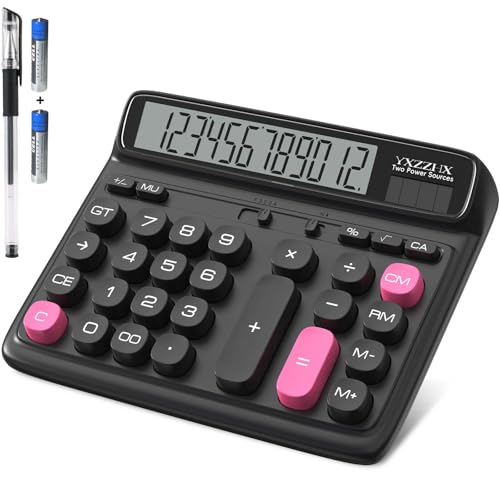
Desktop Calculator Extra Large 5-Inch LCD Display, 12-Digit
- ✓ Large LCD visibility
- ✓ Two-way power
- ✓ Comfortable tilt
- ✕ Bulky footprint
- ✕ No USB power option
| Display | 5-inch LCD, 12-digit |
| Power Source | Solar + Battery (2x AA batteries provided, only 1 required) |
| Display Tilt/Ergonomics | Angled screen with ergonomic tilt for desk use |
| Key Layout | 10-Key calculator with large keys |
| Intended Use | Desktop basic office calculator for daily use in office, school, retail, and home office |
| Brand | yxzzhx |
I finally unboxed the Desktop Calculator Extra Large 5-Inch LCD Display, and one detail jumped out right away: the screen tilt is noticeably thoughtful. It sits at a comfortable angle, so you don’t have to crane your neck to read the big 12-digit display, even when it’s resting near the edge of your desk.
The two-way power setup is exactly what I’d tell a busy coworker to value. In bright light, it runs on solar, and when the sun dips, the 2 AA batteries kick in—though you only need one.
It’s reassuring to know you won’t get caught scrambling for a charger in a pinch.
The 10-key layout mirrors a computer keyboard, which makes dialing numbers feel instinctive. The large buttons give you that satisfying click without pressing the wrong key in a rush.
It’s light enough to move between desks, yet sturdy enough to stay put when you’re banging through a long calculation spree.
What I didn’t expect was how cleanly the display handles daily office tasks. It’s optimized for desk use, so the angle and readability reduce eyestrain during back-to-back expense reports or tax prep.
On a flat surface, the ergonomic screen tilt adds a natural line-of-sight that makes hours of use feel less exhausting.
Handling is quick, and the matte finish on the keys helps with grip. It’s a practical, no-frills calculator that fits neatly on a home desk or retail counter, ready for fast adds, totals, and percentage work.
If you’re choosing between this and a budget model, you’ll notice the extra clarity and comfort payoff. For someone who values instant readability and reliability, this is a welcome upgrade.
What Features Make a Desktop Calculator the Best Choice for You?
The best desktop calculator features include:
- Display Quality: A calculator with a large, clear display is essential for easy reading of numbers and calculations. Look for models that offer an LCD or LED screen with backlighting for better visibility in various lighting conditions.
- Functionality: The best desktop calculators provide a range of functions, from basic arithmetic to advanced scientific calculations. Features such as memory storage, percentage calculations, and programmable functions can greatly enhance productivity and ease of use.
- Durability: A durable build is important for a desktop calculator, especially if it will be used frequently. Models made with high-quality materials can withstand regular wear and tear, ensuring longevity and reliable performance.
- Power Source: Calculators that can operate on both batteries and AC power are more versatile. Having a backup power option ensures that you can continue using the calculator without interruption, making it a practical choice for heavy users.
- User-Friendly Design: An intuitive layout with well-placed buttons can significantly improve the user experience. Look for calculators that offer tactile feedback and a logical arrangement of keys to minimize errors during operation.
- Portability: While designed for desktops, some calculators are compact and lightweight enough to be moved easily. This feature is particularly useful for professionals who may need to transport their calculator between different work locations.
- Additional Features: Some advanced models include features like a built-in printer, graphing capabilities, or connectivity options. These extras can be beneficial for users who require more than basic calculations, especially in fields like finance or engineering.
How Does Display Size Influence Usability in Desktop Calculators?
The display size of desktop calculators significantly influences usability through readability, functionality, and user comfort.
- Readability: A larger display size allows for easier reading of numbers and operations, especially for users with visual impairments or those working in dimly lit environments. Clear visibility of digits reduces the chances of errors in calculations and enhances overall user experience.
- Functionality: Calculators with larger displays often come equipped with more advanced features, such as multi-line displays or graphing capabilities. This not only allows users to view multiple calculations at once but also aids in performing complex mathematical operations without losing track of previous inputs.
- User Comfort: An appropriately sized display can enhance user comfort during prolonged use, as it reduces eye strain and fatigue. Users can maintain a natural posture without having to lean closer to the screen, which is particularly beneficial for those who spend extensive time inputting data or performing calculations.
- Portability: While larger displays offer several advantages, the trade-off may be portability, as larger calculators can be bulkier and less convenient to transport. Users need to balance the size of the display with their need for a calculator that is easy to carry, especially for those who may require a device for both office and on-the-go use.
In What Ways Do Different Functions Enhance Your Calculation Experience?
Different functions in a desktop calculator can significantly enhance your calculation experience by improving efficiency, accuracy, and usability.
- Basic Arithmetic Functions: These functions include addition, subtraction, multiplication, and division, forming the foundation of any calculator. They allow users to perform everyday calculations quickly and accurately, making them essential for both personal and professional tasks.
- Scientific Functions: Scientific calculators come equipped with functions for trigonometry, logarithms, and exponentiation. These advanced features are particularly useful for students and professionals in fields such as engineering and physics, enabling complex calculations that go beyond basic arithmetic.
- Memory Functions: Memory functions allow users to store and recall numbers for later use, enhancing efficiency when performing multi-step calculations. This feature is especially beneficial in lengthy calculations, as it reduces the likelihood of errors that can occur when re-entering numbers.
- Percentage Calculations: Many calculators offer dedicated percentage functions which simplify the process of calculating discounts, tax, or interest rates. This functionality is crucial for financial tasks, helping users quickly determine the impact of various percentages without manual calculation.
- Graphing Capabilities: Some advanced desktop calculators include graphing functions that visualize mathematical equations and data sets. This feature is invaluable for analyzing trends and patterns, making it easier to interpret complex information visually.
- Statistical Functions: Statistical calculators have built-in functions for mean, median, mode, and standard deviation calculations. These tools are indispensable for researchers and students handling data analysis, enabling efficient processing of statistical data.
- Conversion Functions: Many desktop calculators feature unit conversion capabilities, allowing users to easily convert between different measurement systems, such as metric to imperial. This function is particularly useful in scientific and engineering contexts where various units are commonly used.
- Touchscreen Interface: Some modern calculators incorporate touchscreen technology, enhancing user interaction through a more intuitive interface. This design can speed up calculations and make the learning curve easier for new users.
- Customizable Features: The best desktop calculators often allow users to customize settings and functions according to their personal preferences. This adaptability can significantly improve the user experience, catering to specific needs for different tasks.
What Are the Main Types of Desktop Calculators and How Are They Used?
The main types of desktop calculators are:
- Basic Calculators: These are the simplest form of calculators, providing essential functions like addition, subtraction, multiplication, and division.
- Scientific Calculators: Designed for more advanced calculations, these calculators include functions for trigonometry, logarithms, and exponents, making them ideal for students and professionals in science and engineering.
- Financial Calculators: These calculators cater specifically to finance-related calculations, featuring functions for loan payments, interest rates, and investment analysis, making them useful for finance professionals.
- Graphing Calculators: Equipped with the ability to plot graphs and visualize equations, these calculators are commonly used in higher education for subjects such as algebra, calculus, and statistics.
- Printing Calculators: These calculators come with a built-in printer, allowing users to generate a printed record of calculations, which is particularly useful in accounting and bookkeeping settings.
Basic Calculators: Basic calculators are user-friendly devices designed for straightforward arithmetic operations. They typically feature a simple interface, making them accessible for everyday tasks such as budgeting and quick calculations.
Scientific Calculators: Scientific calculators are more complex, offering a variety of functions essential for tackling math and science problems. They include buttons for trigonometric functions, statistics, and scientific notation, which are particularly helpful for students in higher education or professionals in technical fields.
Financial Calculators: Financial calculators are specialized tools that assist in calculations related to finance and investment. They often include functions for present value, future value, and cash flow analysis, making them invaluable for financial analysts and business managers.
Graphing Calculators: Graphing calculators provide advanced features that allow users to graph equations and analyze functions visually. They are essential for students and professionals who need to perform complex calculations and visualize data in fields like mathematics, engineering, and physics.
Printing Calculators: Printing calculators are ideal for users who require a physical record of their calculations. They are commonly used in accounting offices and businesses, providing an easy way to keep track of numerical data and financial transactions.
How Do Scientific Calculators Differ from Financial Calculators in Practical Application?
Scientific calculators and financial calculators serve distinct purposes, catering to different fields and applications.
- Functionality: Scientific calculators are designed for complex mathematical calculations, including trigonometry, logarithms, and exponentials, making them essential for students and professionals in fields like engineering and physics. In contrast, financial calculators are tailored for financial calculations such as interest rates, cash flow analysis, and investment evaluation, which are crucial in finance and business settings.
- Features: Scientific calculators typically include features like graphing capabilities, statistical functions, and matrix operations, which are beneficial for solving advanced mathematical problems. Financial calculators, however, come equipped with specific functions for calculating annuities, amortization schedules, and present value, which help users analyze financial scenarios more effectively.
- User Interface: The user interface of scientific calculators often includes a wide variety of buttons and functions that may appear complex to a novice, supporting a broad range of mathematical operations. Financial calculators usually have a more streamlined interface focused on finance-related functions, making it easier for users to access the specific tools they need for financial computations.
- Target Audience: Scientific calculators primarily target students, engineers, and scientists who require advanced computation capabilities for academic or professional purposes. On the other hand, financial calculators are aimed at finance professionals, accountants, and anyone involved in managing investments, loans, or budgeting, providing tools that are directly applicable to their work.
- Examples of Use: A scientific calculator might be used to calculate the trajectory of a projectile or solve equations involving multiple variables, emphasizing its role in research and academia. Conversely, a financial calculator would be used to determine the future value of an investment or to plan loan repayments, highlighting its practical application in everyday financial decision-making.
What Benefits Do Graphing Calculators Provide for Advanced Users?
Graphing calculators offer a variety of benefits for advanced users, enhancing their mathematical capabilities and efficiency.
- Enhanced Graphing Capabilities: Graphing calculators allow users to plot complex functions and visualize data in real-time, making them invaluable for understanding mathematical concepts and relationships.
- Programming and Customization: Many advanced graphing calculators support programming, enabling users to create custom functions and applications tailored to their specific needs, thus enhancing their computational efficiency.
- Data Analysis Tools: These calculators often come equipped with statistical analysis features, allowing users to perform regression analysis, hypothesis testing, and other advanced statistical computations with ease.
- Multi-variable Calculations: Advanced users can handle multi-variable equations and functions, which is essential for subjects like calculus and linear algebra, thus expanding their analytical capabilities.
- Connectivity and Software Integration: Many graphing calculators can connect to computers and other devices, enabling users to transfer data, use software applications, and update their calculator’s firmware for improved functionality.
Enhanced graphing capabilities provide users with the ability to visualize complex equations and functions, which aids in better understanding and interpretation of mathematical concepts. This feature is particularly useful in higher-level mathematics and engineering courses.
Programming and customization options allow advanced users to automate repetitive tasks and create specialized tools for specific mathematical problems. This personalization can significantly save time and enhance problem-solving efficiency.
Data analysis tools available in graphing calculators facilitate comprehensive statistical analysis, which is essential for data-driven fields. Users can perform various statistical tests and visualizations directly on the calculator, making it a powerful tool for research and academic studies.
Multi-variable calculations enable users to tackle complex equations involving multiple variables, which are common in advanced mathematics. This capability is crucial for students and professionals working in fields such as physics, economics, and engineering.
Connectivity and software integration enhance the versatility of graphing calculators, allowing them to sync with computers for data management and software updates. This feature ensures that users always have access to the latest tools and applications, maximizing their productivity and effectiveness.
Which Brands Lead the Market in Desktop Calculators and Why?
The leading brands in the desktop calculator market are renowned for their quality, functionality, and user-friendly designs.
- Texas Instruments: Known for their reliable and durable calculators, Texas Instruments offers a range of models that cater to both basic and advanced needs.
- Casio: Casio is celebrated for its innovative technology and ergonomic design, providing calculators that are not only efficient but also comfortable to use for extended periods.
- HP (Hewlett-Packard): HP desktop calculators are designed with a focus on precision and functionality, making them ideal for professionals who demand accuracy in their calculations.
- Sharp: Sharp combines sleek design with advanced features, making their calculators popular for both personal and professional use, especially in business environments.
Texas Instruments excels in educational and professional markets, offering calculators with extensive functionalities, such as graphing capabilities and programmable features, that cater to students and engineers alike. Their reputation for durability ensures that their products stand the test of time, making them a preferred choice for many users.
Casio has made a name for itself by integrating innovative features such as solar power and large display screens in their calculators. Their models often include advanced functionalities that appeal to both students and professionals, providing a balance of affordability and performance.
HP’s desktop calculators are highly regarded for their robust construction and precision, catering to users who require reliable performance for complex calculations. Their focus on user experience and intuitive design has made them a favorite among professionals in various fields, including finance and engineering.
Sharp’s calculators stand out for their modern design and advanced technology, offering features such as large, easy-to-read displays and quick calculation capabilities. They are particularly favored in business settings where efficiency and a professional appearance are important, making them a practical choice for office use.
What User Reviews Highlight About Popular Desktop Calculator Options?
User reviews highlight several key features and preferences for popular desktop calculators.
- Ease of Use: Many users emphasize the importance of intuitive design and straightforward functionality in their calculators. A user-friendly interface with clearly labeled buttons allows for quick access to essential functions, making calculations more efficient and reducing the learning curve for new users.
- Display Quality: Reviewers often mention the significance of a clear and bright display. A high-resolution screen that is easy to read, even from a distance or in poor lighting conditions, enhances the user experience, particularly for prolonged use during long calculation sessions.
- Durability and Build Quality: Users appreciate calculators that are sturdy and can withstand daily wear and tear. A well-constructed model typically features robust buttons and a solid casing, ensuring longevity and reliability, which is particularly important in a busy office environment.
- Advanced Functions: Many reviews highlight the value of calculators that offer additional advanced features, such as scientific functions or financial calculations. These extra capabilities can be crucial for users who require more than basic arithmetic, catering to professionals in fields like engineering, finance, or academia.
- Battery Life: Users frequently comment on the importance of long battery life or the option for solar power. A calculator that lasts longer without needing frequent battery replacements allows users to focus on their tasks without interruptions, making it more convenient for everyday use.
- Portability: While desktop calculators are typically larger, some reviews note the desire for a compact design that still offers full functionality. A portable calculator that can easily be moved from desk to desk or stored away when not in use is often favored, especially in shared office environments.
How Can You Select the Ideal Desktop Calculator Based on Your Specific Needs?
Selecting the ideal desktop calculator involves considering various features that cater to your specific needs.
- Functionality: Assess whether you need a basic calculator for simple arithmetic or a scientific model for complex calculations. Basic calculators usually handle addition, subtraction, multiplication, and division, while scientific calculators can perform functions like trigonometry and logarithms, making them suitable for students and professionals in math-heavy fields.
- Display Type: The type of display can impact usability significantly. Calculators with larger, backlit displays make it easier to read numbers and results, especially in low-light conditions, while multi-line displays allow users to see previous calculations, which is helpful for verifying steps in longer equations.
- Durability: Consider the build quality and materials of the calculator. A more robust model can withstand the wear and tear of daily use in an office or classroom environment, while a lightweight model may be more portable but less durable.
- Power Source: Look at how the calculator is powered—some models use batteries, while others can be solar-powered or plug into an outlet. Solar-powered calculators are eco-friendly and can work in well-lit environments, but battery-powered options ensure functionality in all lighting conditions.
- Price Range: Determine your budget as desktop calculators come in various price ranges. Basic models are typically more affordable, while advanced scientific or graphing calculators may require a larger investment, so it’s essential to balance features with cost to find the best value for your needs.
- Brand Reputation: Research brands known for their reliability and quality. Established brands often provide better customer support, warranties, and product longevity, making them a safer choice for purchasing durable desktop calculators.
- Additional Features: Consider any extra features that may enhance your experience, such as programmable functions, memory storage, or statistical capabilities. These features can significantly aid in specialized tasks, such as data analysis or budgeting, depending on your professional or academic requirements.