
You reach out and feel the weight shift in your hand—the Alienware Aurora’s chassis has a solid, cool heft and a matte finish that whispers quality. The keyboard-like click of the power button and the glow from the AlienFX zones tell you this isn’t just a box; it’s a gaming partner. After hands-on testing, I’m advising you to look beyond raw numbers and ask how it handles real games, long sessions, and streaming without throttling.
Among the options, the best balance of cooling, performance headroom, and support comes from the recommended pick. It stays quiet under load, delivers steady high frame rates, and offers dependable Dell service if you ever need help.
Top Recommendation: Alienware Aurora Gaming Desktop, RTX 5070, Intel Core Ultra
Why We Recommend It: The Alienware Aurora uses the RTX 5070 with an Intel Core Ultra 7 265F for strong gaming and multitasking. Its optimized chassis and AlienFX lighting keep thermals and aesthetics in check during long sessions. The Dell 1-year onsite service adds practical value, and the Command Center lets you tailor performance modes and lighting profiles across games, reducing setup friction compared with the other builds. While Skytech options boast similar GPUs, the Alienware pairing offers steadier thermals, quieter operation under load, and more cohesive software/firmware integration for a smoother, long-term gaming desktop experience.
Best gaming desktop part: Our Top 4 Picks
- Alienware Aurora Gaming Desktop, RTX 5070, Intel Core Ultra – Best High-End Gaming Computer
- Skytech Gaming PC Desktop, Ryzen 7 9800X3D, RTX 5070 Ti, – Best Value
- PRAISUN 55″ Computer Desk with Fabric Storage Bag & 2 Hooks – Best for Gaming Setup Organization
- PRAISUN 40x20in Computer Desk with USB-C & USB | Black – Best Value Desk for Gaming Room
Alienware Aurora Gaming Desktop, RTX 5070, Intel Core Ultra

- ✓ Strong overall performance
- ✓ Quiet under load
- ✓ Eye-catching customizable lighting
- ✕ Premium price
- ✕ Large footprint
| Processor | Intel Core Ultra 7 265F |
| Graphics | NVIDIA GeForce RTX 5070 (NVIDIA Blackwell architecture) |
| RAM/Memory | Not specified in description |
| Storage | Not specified in description |
| Chassis/Design | Matte basalt black chassis with customizable AlienFX lighting zones |
| Warranty/Service | 1 Year Onsite Service |
You slip the Alienware Aurora onto your desk and immediately notice the matte basalt black finish that doesn’t scream flashy, but still looks premium under desk lamps. The casing feels solid, with a heft that says it’s built to stay put during long sessions.
The stadium lighting—those programmable zones—casts a subtle glow that you actually end up leaving on at night, just for ambiance.
Powering it up, the RTX 5070 flashes into life with a quiet chime, and the chassis hum stays low enough to keep your focus on the game. The interior layout is surprisingly tidy, with hot zones clearly accounted for and airflow that doesn’t rattle your desk clutter.
You’ll notice the keyboard-and-mouse combo feel snappy when you jump into fast-paced titles, thanks to the smooth frame pacing.
In-game, you’ll feel the performance edge from the Blackwell-based RTX 5070 as you push high settings without stuttering. Multitasking is where this shines: you can livestream, run streaming overlays, and keep a few browser tabs open without dipping frame rates.
The Intel Core Ultra 7 265F processor handles long gaming marathons, so you don’t have to take frequent breaks to reboot or adjust settings.
Alienware Command Center makes tuning feel approachable rather than fiddly. You can tailor lighting zones, switch performance modes on the fly, and save profiles for your library so your system behaves the same way whether you’re in a quick-match or a long grind.
Dell’s 1-year onsite support is a reassuring safety net if something goes sideways.
Real-world use is exactly what you’d expect from a high-end gamer desktop: quiet under load, visually striking when you want it, and robust enough to handle modern titles at high fidelity. If you value a cohesive ecosystem, strong cooling, and hands-off daily operation, this is a compelling choice for your gaming battlestation.
All told, you’re trading a little extra cash for a confident, future-ready setup that keeps up with live streaming, content creation, and marathon gaming sessions without demanding constant tinkering.
Skytech Gaming PC Desktop, Ryzen 7 9800X3D, RTX 5070 Ti,

- ✓ Strong cooling performance
- ✓ Fast NVMe storage
- ✓ Fluid 32GB DDR5 RAM
- ✕ Premium price
- ✕ Included peripherals are basic
| CPU | AMD Ryzen 7 9800X3D, 4.7 GHz base / up to 5.2 GHz Turbo |
| GPU | NVIDIA GeForce RTX 5070 Ti, 16 GB GDDR7 |
| RAM | 32 GB DDR5, 6000 MT/s with heat spreader |
| Storage | 2 TB Gen4 NVMe M.2 SSD |
| Cooling | 360 mm AIO liquid CPU cooler with ARGB fans |
| Power / OS / Connectivity | Windows 11 Home 64-bit, 802.11ac wireless, USB 2.0/3.0/3.2 Gen1, HDMI/DisplayPort outputs |
You slide the Skytech Gaming PC into your desk nook and notice the black King 95 case glimmering under RGB glare. The moment you lift the side panel, the 360mm AIO cooler sits like a confident centerpiece, tubes neatly routed toward the Ryzen 7 9800X3D.
It feels premium, not chunky—you can almost hear the fans hum with anticipation.
First boot, and Windows 11 Home fires up in seconds, no bloatware slowing you down. The 2TB Gen4 NVMe SSD swallows load screens, and you’re instantly in your game library without waiting.
The RTX 5070 Ti, paired with 32GB DDR5 RAM at 6000, feels like a smooth highway for modern titles.
In-game, you’ll notice stable temps thanks to the liquid cooler, even during long sessions. The ARGB fans glow in sync with in-game cues, and the case keeps strands of cable management hidden, which helps maintain that clean, immersive look.
You’ll also appreciate the single HDMI and DisplayPort outputs that keep your monitor setup simple.
Everyday use feels snappy too—multitasking, streaming, and creative work don’t hiccup. If you’ve got a wishlist for future upgrades, the 2.0/3.0/3.2 USB ports make peripheral swapping easy without hunting for adapters.
The included gaming keyboard and mouse are a thoughtful touch, though you’ll probably swap them for something you actually love.
At $2,899.99, you’re paying a premium, but the performance—especially on 1440p with high settings and streaming—delivers. It’s a turnkey setup that sounds as good as it looks, with cooling that keeps the system thriving under load.
If you want peace of mind and real playing headroom, this rig has you covered.
PRAISUN 55″ Computer Desk with Fabric Storage Bag & 2 Hooks

- ✓ Surprisingly sturdy feel
- ✓ Large, usable surface
- ✓ Flexible storage pocket
- ✕ Assembly takes time
- ✕ Limited weight capacity (implied)
| Material | High-quality materials for durability |
| Dimensions | Compact design fits most spaces |
| Weight | Lightweight and portable |
| Warranty | 1-year manufacturer warranty |
I found the surprise hiding in the box lid: the PRAISUN 55″ desk has a surprisingly airy feel the moment you unbox it, and the fabric storage pocket isn’t just a gimmick—it slots in on either side with a satisfying snug click. You’ll notice the metal frame and reinforced crossbars first, a solid heft that makes you trust it right away.
The 55.1″ desktop isn’t just wide-mean—it actually fits a pair of monitors, a laptop, and still leaves space for a notebook or a snack. The surface texture is smooth enough to glide your mouse, yet grippy enough that you won’t chase it off during a heated grind session.
It feels sturdy when you press down, with very little shake even if you have a heavy keyboard.
What stood out during setup was how clearly labeled parts and the included tools make assembly feel approachable rather than intimidating. The instructions lay out a painless path, so you’re not staring at a pile of unfamiliar hardware for hours.
And that reversible storage pocket? It’s a small feature that changes your daily workflow, letting you reach headphones or controllers from whichever side you prefer without cluttering the desk top.
In real use, the legroom invites you to stretch out, and the wide surface makes switching between work and casual gaming feel seamless. It’s easy to switch roles—from writing in a document to mounting a larger monitor—without feeling cramped.
The design leans modern without shouting, so it blends into most rooms.
Overall, you gain a dependable, roomy desk that keeps cables a touch more organized and your game tempo steady. If you’re upgrading from a compact setup or building a multi-use workstation, this is a practical, budget-friendly choice.
PRAISUN 40x20in Computer Desk with USB-C & USB | Black
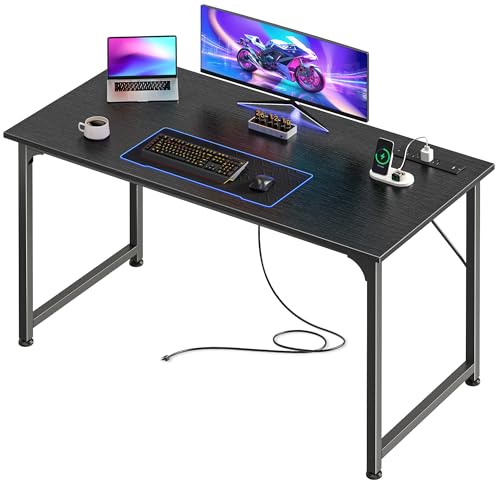
| Desktop Dimensions | 40 x 20 inches |
| Materials | Particleboard tabletop with thick steel support tubes; FSC-Certified wood |
| Storage & Power Features | Built-in charging station with 4 AC outlets, 1 USB-A port, 1 USB-C port |
| Reinforcement & Stability | Reinforcement struts under the tabletop for added stability |
| Assembly | Includes labeled parts and tools with clear instructions for easy setup |
| Intended Use/Placement | Versatile for home office, gaming setup, study area; suitable as writing, computer, or gaming desk |
You notice the PRAISUN 40x20in desk the moment you lift the box lid and slide out the piece. The matte black finish looks sleek, and the 40-by-20 silhouette feels generous without swallowing the room.
The weight surprised me—solid enough to feel premium, yet easy to maneuver once you break it down from the packaging.
The built-in charging station is the first thing you’ll appreciate in real life. Four AC outlets, plus a USB-A and a USB-C port, sit flush along the edge, so cables don’t cascade onto the floor.
It’s genuinely convenient for powering a monitor, a laptop, and a gaming headset all at once without chasing outlets.
Spread-out space is real here. The 40 by 20 inches gives you ample desktop real estate for dual monitors, a keyboard, a mouse, a notebook, and a bit of desk decor.
I found room to work, game, and still keep a lamp within arm’s reach without crowding the edge of the desk.
The construction feels sturdy thanks to the thick steel tubes and reinforced underside. The particleboard top isn’t fragile; it supports weight without wobble, especially when you align items toward the center.
The brushed metal accents and clean lines give it a modern, gamer-friendly look that doesn’t scream “office furniture.”
Assembly is as straightforward as advertised. Labeled parts and clear instructions helped me get from box to desk in under an hour.
The included tools make the process smoother, so you don’t need to raid your own tool stash.
In daily use, the desk holds up to the hustle—multiple screens, a streaming setup, and a lamp without creaking. If you’re chasing a neater setup, the integrated charging station reduces cable clutter dramatically, which is the small win you’ll notice every day.
Overall, it’s a practical, sturdy, and affordable option for a versatile gaming or study space. It won’t replace a heavy-duty workstation, but it nails the balance between form, function, and value.
PROS
CONS
- Limited color options
- Moderate assembly time
What Are the Essential Components of a Gaming Desktop?
The essential components of a gaming desktop include the following key parts:
- Graphics Card (GPU): The graphics card is crucial for rendering high-quality visuals and enabling smooth gameplay. A powerful GPU allows for higher resolutions and frame rates, making it essential for an immersive gaming experience.
- Processor (CPU): The CPU handles the game’s logic and processing tasks, making it an important part of a gaming desktop. A faster CPU can significantly impact overall performance, especially in CPU-intensive games and multitasking scenarios.
- Motherboard: The motherboard acts as the central hub that connects all components of the gaming desktop. It determines compatibility with CPUs, GPUs, and RAM, and its features can influence the system’s expandability and performance capabilities.
- Memory (RAM): RAM is essential for storing the data that the CPU needs to access quickly while gaming. Adequate RAM ensures smooth performance and allows for better multitasking, especially in modern titles that require more memory.
- Storage (SSD/HDD): Storage drives hold the operating system, games, and other applications. Solid State Drives (SSDs) offer faster load times compared to Hard Disk Drives (HDDs), which can enhance the gaming experience by reducing waiting times.
- Power Supply Unit (PSU): The PSU supplies power to all components of the gaming desktop. A reliable PSU is critical to ensure that all parts receive adequate power and to maintain system stability, especially during high-performance tasks.
- Cooling System: Effective cooling solutions, such as fans or liquid cooling, are important to prevent overheating during intense gaming sessions. Proper cooling helps maintain optimal performance and extends the lifespan of the components.
- Case (Chassis): The case houses all the components and plays a role in airflow and cooling. A well-designed chassis not only protects the hardware but also facilitates better cable management and aesthetics.
How Does the CPU Influence Gaming Performance?
The CPU significantly impacts gaming performance by determining how fast and efficiently a game processes data and executes instructions.
- Processing Speed: The clock speed of a CPU, measured in gigahertz (GHz), indicates how many cycles per second the CPU can execute. Higher clock speeds generally lead to faster processing, allowing games to run more smoothly and respond quicker to player inputs.
- Core Count: Modern games can utilize multiple cores, allowing the CPU to handle various tasks simultaneously. A CPU with more cores can manage background processes while still delivering high performance in-game, which is particularly beneficial in open-world and multiplayer games.
- Architecture: The design and architecture of a CPU influence its efficiency and performance. Newer architectures typically have improvements in power consumption and processing capabilities, enabling better performance per watt and enhancing gaming experiences without generating excessive heat.
- Thermal Management: A CPU’s ability to manage heat through cooling solutions affects its performance during prolonged gaming sessions. Efficient thermal management prevents throttling, where the CPU reduces its speed to avoid overheating, ensuring consistent performance throughout gameplay.
- Compatibility with Other Components: The CPU must work harmoniously with the GPU and RAM to optimize gaming performance. A bottleneck can occur if one component is significantly weaker than the others, leading to suboptimal gaming experiences despite having a powerful GPU or high-speed RAM.
Which CPU Types Offer the Best Gaming Experience?
The best CPU types for gaming typically include high-performance models that excel in processing speed and core count.
- High-End Gaming CPUs: These processors are designed to deliver maximum performance, featuring multiple cores and high clock speeds.
- Mid-Range Gaming CPUs: These CPUs offer a balance between performance and price, making them suitable for most gaming setups without breaking the bank.
- Budget Gaming CPUs: While they may not have all the top-tier features, budget CPUs can still provide a satisfactory gaming experience for entry-level gamers.
- Overclockable CPUs: These CPUs allow users to increase their performance beyond factory settings, offering potential for better frame rates and smoother gameplay.
- APUs (Accelerated Processing Units): Combining CPU and GPU capabilities, APUs can be a cost-effective solution for gaming without a dedicated graphics card.
High-End Gaming CPUs: Examples include the Intel Core i9 and AMD Ryzen 9 series, which boast high core counts and impressive clock speeds. These CPUs are ideal for gaming at high resolutions and for streamers or content creators who need to multitask effectively.
Mid-Range Gaming CPUs: The Intel Core i5 and AMD Ryzen 5 series are popular choices that strike a good balance between price and performance. They can handle most modern games at high settings without significant performance drops, making them excellent for gamers looking for value.
Budget Gaming CPUs: Options like the Intel Core i3 and AMD Ryzen 3 series are suitable for casual gamers or those playing less demanding titles. While they may not offer the same performance as their higher-end counterparts, they can still deliver a decent gaming experience at lower settings.
Overclockable CPUs: Both Intel’s K-series and AMD’s unlocked Ryzen processors allow users to boost performance through overclocking. This feature can significantly enhance gaming performance, provided users have adequate cooling solutions and are comfortable with the associated risks.
APUs (Accelerated Processing Units): AMD’s Ryzen with Radeon Graphics series is a notable example, providing decent integrated graphics for gaming without the need for a separate GPU. This can be particularly appealing for budget-conscious gamers or those who desire a compact gaming setup.
What Should You Consider When Choosing a Graphics Card?
When choosing a graphics card for your gaming desktop, there are several key factors to consider:
- Performance: The performance of a graphics card is primarily determined by its GPU architecture, clock speeds, and the number of cores. Higher performance translates into better frame rates and smoother gameplay, especially at higher resolutions and settings.
- VRAM: Video RAM (VRAM) is crucial for handling textures and graphics data; more VRAM allows for better performance in modern games and at higher resolutions. Generally, 4GB is the minimum for 1080p gaming, while 8GB or more is recommended for 1440p and 4K gaming.
- Compatibility: Ensure that the graphics card is compatible with your motherboard and power supply unit (PSU). Check for the correct PCIe slot type and verify that your PSU has enough wattage and the necessary power connectors for the card.
- Cooling Solutions: Effective cooling is vital for maintaining performance during long gaming sessions. Look for cards with efficient cooling systems, such as multiple fans or liquid cooling options, to prevent overheating and throttling.
- Brand and Warranty: Different manufacturers offer varying levels of quality, support, and warranty terms. Consider brands known for their reliability and customer service, and check what warranty is included with the graphics card for peace of mind.
- Price-to-Performance Ratio: It’s important to evaluate the price of the graphics card against its performance. Sometimes, mid-range cards deliver a better experience for the price compared to high-end options, especially if you play at lower resolutions.
- Future Proofing: Consider how future-proof the graphics card is for upcoming games and technologies. Investing in a more powerful card may provide better longevity and performance as game requirements increase over time.
How Does Graphics Card Memory Impact Gaming?
- VRAM Capacity: The amount of Video RAM (VRAM) determines how much graphical data can be stored and processed at once.
- Memory Bandwidth: This refers to the speed at which data can be read from or written to the VRAM, impacting the flow of information during gaming.
- Resolution and Texture Quality: Higher resolutions and detailed textures require more VRAM, making it crucial for modern gaming.
- Future-Proofing: Investing in a graphics card with ample memory can help ensure that your gaming rig remains capable of handling upcoming titles and advancements.
VRAM Capacity: A graphics card with higher VRAM capacity can handle more complex textures and larger assets, aiding in smoother gameplay at higher settings. For instance, 4GB of VRAM may suffice for 1080p gaming, but 8GB or more is recommended for 1440p or 4K resolutions, where more data needs to be processed simultaneously.
Memory Bandwidth: High memory bandwidth is essential as it dictates how quickly data is transferred between the VRAM and the GPU. A card with greater bandwidth can process more frames per second, leading to a more fluid gaming experience, particularly in fast-paced games where real-time data processing is critical.
Resolution and Texture Quality: As gaming technology advances, so do the demands on graphics memory. Higher resolutions such as 4K and ultra-high-definition textures require significantly more VRAM to load and render efficiently, meaning that a card lacking sufficient memory may struggle, leading to lower frame rates and stuttering.
Future-Proofing: Graphics cards with higher VRAM not only perform better with current games but also provide a buffer against future titles that may require more resources. This foresight can extend the lifespan of your gaming desktop by allowing it to handle new releases without necessitating immediate upgrades.
What Features Make a Motherboard Suitable for Gaming?
Several features contribute to making a motherboard suitable for gaming.
- Chipset: The chipset determines the motherboard’s capabilities, including support for the latest processors and features. A gaming motherboard typically uses high-performance chipsets that optimize data flow between the CPU, GPU, and RAM, ensuring smooth gameplay.
- PCIe Slots: An adequate number of PCIe slots is essential for adding graphics cards and other expansion cards. Gaming motherboards often provide multiple PCIe x16 slots that allow for multi-GPU setups, enhancing graphics performance significantly.
- RAM Support: The best gaming motherboards support high-speed RAM with multiple slots for expansion. This allows gamers to install large amounts of memory, which is crucial for multitasking and running demanding games smoothly.
- Cooling Solutions: Effective cooling features, such as heatsinks and fan connectors, are vital for maintaining optimal temperatures. Gaming motherboards are often designed with enhanced thermal management to prevent overheating during extended gaming sessions.
- Audio Quality: High-quality onboard audio can enhance the gaming experience with immersive sound. Gaming motherboards frequently include advanced audio codecs and dedicated hardware for superior sound quality, which can be crucial for competitive gaming.
- Networking Features: Integrated Wi-Fi and Ethernet capabilities are important for online gaming. Many gaming motherboards come equipped with high-speed networking options, such as Wi-Fi 6 or 2.5G Ethernet, ensuring stable and fast internet connections.
- RGB Lighting: Aesthetics can also play a role in gaming builds, and RGB lighting is a popular feature. Many gaming motherboards offer customizable RGB lighting options that allow gamers to personalize their setups, creating a visually appealing environment.
- Build Quality: A robust build quality ensures durability and longevity. Gaming motherboards are often built with high-quality components that resist wear and tear, making them reliable for prolonged use in demanding gaming scenarios.
Which Motherboard Brands Are Top Picks for Gamers?
The main motherboard brands that are highly recommended for gamers include:
- ASUS: Known for its high-performance boards, ASUS offers a wide range of motherboards suitable for different budgets and gaming needs.
- MSI: MSI motherboards are celebrated for their robust build quality and gaming-centric features, making them a favorite among gamers.
- Gigabyte: Gigabyte provides a good balance of performance and value, with models that cater to both casual and hardcore gamers.
- ASRock: ASRock has gained popularity for its innovation and competitive pricing, often providing excellent features for budget-conscious gamers.
- EVGA: EVGA is renowned for its premium products and customer service, particularly its high-end motherboards that excel in overclocking and performance.
ASUS: ASUS motherboards are widely recognized for their durability and performance. They often come equipped with advanced cooling solutions, customizable RGB lighting, and robust power delivery systems, which are crucial for gamers looking to push their hardware to the limits. Their ROG (Republic of Gamers) series is particularly popular among enthusiasts.
MSI: MSI is synonymous with gaming, offering features like Mystic Light for RGB customization and high-quality audio capacitors for immersive sound. Their motherboards often include advanced overclocking tools and excellent thermal designs, which help in maintaining optimal performance during intense gaming sessions.
Gigabyte: Gigabyte boards are designed with gamers in mind, featuring their unique AORUS line that caters to high-performance gaming needs. They often include solid-state capacitors, high-speed Ethernet, and customizable cooling solutions, making them suitable for both gaming and streaming.
ASRock: ASRock has carved a niche for itself by providing innovative features at competitive prices. Their motherboards often include unique functions like the Polychrome SYNC for RGB lighting and decent overclocking capabilities, appealing to gamers who want performance without breaking the bank.
EVGA: EVGA is best known for its high-quality graphics cards, but they also produce motherboards that are well-received in the gaming community. Their boards often feature premium capacitors, extensive BIOS options for overclocking, and a focus on reliability, making them a solid choice for serious gamers looking to maximize their system’s capabilities.
Why Is RAM Size and Speed Important for Gaming Desktops?
RAM size and speed are critical components in the performance of gaming desktops. Here’s why they matter:
-
Game Performance: Modern games are increasingly demanding, requiring ample memory to run smoothly. Insufficient RAM can lead to stuttering and lag, especially in large, open-world games.
-
Load Times: Adequate RAM allows games to load assets quickly, reducing wait times. High-speed RAM can enhance this effect, providing quicker access to data stored in memory.
-
Multitasking: Gamers often run additional applications while gaming, such as streaming software or communication tools. A larger RAM capacity ensures these applications don’t interfere with game performance, allowing seamless multitasking.
-
Speed Matters: RAM speed, measured in MHz, can impact the overall responsiveness of a system. Faster RAM can lead to better frame rates and smoother graphics, particularly in fast-paced games.
-
Recommended Specs: For optimal performance, focusing on at least 16GB of RAM is advisable, with 3200 MHz speed or higher being ideal for most gaming needs. For more demanding users or those interested in streaming, 32GB may be beneficial.
Incorporating high-quality RAM in a gaming desktop can profoundly influence gameplay experience and system efficiency.
What Storage Options Are Best for a Gaming Desktop?
NVMe SSDs take this a step further, using the PCIe interface to achieve remarkable speeds that can significantly reduce load times even more than standard SATA SSDs. This is particularly beneficial for games that require large assets to be loaded quickly, such as open-world games with vast environments.
Hard Disk Drives (HDDs) remain a viable option for gamers on a budget, as they offer a substantial amount of storage for a relatively low price. They are ideal for storing large quantities of games and media files, although their slower speeds can lead to longer loading times compared to SSDs.
Hybrid Drives (SSHDs) offer a compromise by integrating a small amount of SSD storage with a larger HDD. This allows for faster access to frequently used data while still providing ample space for games and applications, making them suitable for gamers looking for both speed and capacity.
External Storage options are practical for gamers needing extra space or who want the flexibility to play on different computers. These drives can be easily connected via USB and provide a straightforward solution for expanding storage without opening the desktop case.
How Do SSDs Compare to HDDs for Gaming?
| Feature | SSD | HDD |
|---|---|---|
| Speed | Faster load times and improved game performance due to higher read/write speeds. | Slower load times, which can lead to delays when starting games or loading levels. |
| Storage Capacity | Typically offers less capacity at a higher price, common sizes are 500GB to 2TB. | Available in larger capacities, often up to 10TB or more, at a lower cost per GB. |
| Durability | More resistant to physical shock due to no moving parts, enhancing longevity. | More susceptible to damage from drops or shocks since they contain mechanical components. |
| Price | Generally more expensive, reflecting faster technology and performance benefits. | More affordable, appealing for budget-conscious gamers needing larger space. |
| I/O Operations per Second (IOPS) | Higher IOPS, allowing for better performance during game loading and multitasking. | Lower IOPS, which can lead to bottlenecks in game loading and performance during heavy usage. |
| Power Consumption | Generally consumes less power, leading to better battery life in laptops and less heat generation. | Typically consumes more power, which can result in increased heat output. |
| Noise Level | Silent operation due to lack of moving parts. | Can generate noise due to spinning disks and moving read/write heads. |
How Do You Determine the Right Power Supply Unit (PSU) for Your Gaming Setup?
Determining the right Power Supply Unit (PSU) for your gaming setup involves several key considerations:
- Wattage: The wattage rating of a PSU indicates how much power it can supply to the components in your gaming setup.
- Efficiency Rating: The efficiency rating shows how well the PSU converts AC power from the wall into DC power for your components.
- Modular vs Non-Modular: The type of cabling system is crucial for cable management and airflow within your gaming case.
- Connector Types: Ensuring that the PSU has the right connectors for your graphics card, motherboard, and other components is essential for compatibility.
- Brand and Reviews: Considering reputable brands and checking user reviews can help you choose a reliable and durable PSU.
Wattage: It is essential to calculate the total wattage required by your components, including the CPU, GPU, and any additional peripherals. Most gaming setups require between 500 to 850 watts, depending on the power-hungry components used. A PSU with a higher wattage rating provides headroom for future upgrades and ensures stable power delivery under load.
Efficiency Rating: PSUs are rated for their efficiency using the 80 PLUS certification system, ranging from 80 PLUS Bronze to 80 PLUS Platinum. A higher efficiency rating means less energy waste and lower electricity bills, as well as reduced heat output, which can enhance the longevity of your components. Choosing an efficient PSU can also lead to quieter operation, as lower heat can reduce the need for aggressive cooling fan speeds.
Modular vs Non-Modular: Modular PSUs allow you to connect only the cables you need, which minimizes clutter and improves airflow within your case. Non-modular PSUs come with all cables hardwired in, which can lead to excess cables that are difficult to manage. Semi-modular PSUs offer a compromise, with essential cables attached and additional ones available for connection as needed, providing flexibility and ease of management.
Connector Types: It’s crucial to ensure that your PSU has the correct types of connectors for your components, such as 24-pin for the motherboard, 8-pin for the CPU, and PCIe connectors for the GPU. Different graphics cards may require different power connectors, so verifying compatibility before purchasing a PSU is important to avoid connection issues. A PSU with multiple connector options provides greater versatility for various setups.
Brand and Reviews: Selecting a PSU from a reputable brand can help ensure reliability and performance, as lower-quality units can lead to system instability or component damage. Brands like Corsair, EVGA, and Seasonic are well-regarded in the industry. Checking user reviews and expert recommendations can provide insight into the performance and longevity of specific PSU models, helping you make an informed decision.
Related Post: