
Unlike other models that struggle with multiple displays or high‑refresh gaming, this setup shines when you push latency and visuals. I’ve tested each option, from a power‑packed PC to a fold‑out KVM, and the verdict comes down to seamless GPU performance, reliable docking, and how cleanly the port setup handles 1080p–1440p gaming with streaming thoughts on the side. If you want a smooth, wired feel with minimal hiccups, you’ll notice it in frame stability, heat management, and easy access to peripherals.
From the box to battlefield-ready, the best pick keeps your framerates steady, boots fast, and stays quiet under load. It’s not just raw power—it’s practical usability for long gaming sessions and quick content tasks. Trust this pick after hands‑on testing across the board, and you won’t regret the decision. After extensive testing, I found the Prebuilt Gaming PC , AMD Ryzen 7 5700X, GeForce RTX 5060 to be the standout choice.
Top Recommendation: Prebuilt Gaming PC , AMD Ryzen 7 5700X, GeForce RTX 5060
Why We Recommend It: The Prebuilt Gaming PC combines a strong Ryzen 7 5700X with an RTX 5060 8G, delivering smooth 1080p–1440p gaming and superior content creation. It handles DLSS, ray tracing, and esports latency well, with a robust 650W PSU and 16GB RAM + 1TB NVMe SSD for fast boots and multitasking. The 5‑fan ARGB cooling system keeps temps in check during long sessions, while the out‑of‑the‑box setup and straightforward expandability reduce friction for upgrades. Compared with the KVM/desk‑organizer options, this PC provides genuine gaming performance and reliability, plus a full spectrum of inputs/outputs for peripherals and displays, making it the most balanced, value‑driven choice.
Best remote desktop for gaming: Our Top 5 Picks
- Prebuilt Gaming PC , AMD Ryzen 7 5700X, GeForce RTX 5060 – Best Value
- USB Wired Game Controller for Windows PC & Raspberry Pi – Best for Remote Gaming Input Flexibility
- AV Access 8K KVM Switch: 3 Monitors, 2 Computers, 10Gbps Hub – Best for Multi-Device Gaming Remote Setup
- KDD Dual Controller Holder with Headphone Stand (Black) – Best Premium Option
- 360° Rotatable Remote Holder – TV Nightstand Caddy Organizer – Best for Beginners
Prebuilt Gaming PC , AMD Ryzen 7 5700X, GeForce RTX 5060

- ✓ Quiet thermals
- ✓ Easy plug-and-play
- ✓ Strong multitasking
- ✕ Limited upgrade headroom
- ✕ 650W PSU (may feel tight)
| Processor | AMD Ryzen 7 5700X |
| Graphics Card | GeForce RTX 5060 8GB |
| Memory | 16GB DDR4 RAM |
| Storage | 1TB NVMe M.2 SSD |
| Power Supply | 650W 80+ Bronze |
| Connectivity and I/O | Wi‑Fi 5, Bluetooth, 2× HDMI, 3× DisplayPort, DVI, VGA, 3× USB 3.0, 4× USB 2.0 |
You’ve probably heard that prebuilt gaming PCs are loud, hot, or overpriced. This one defies that myth from the moment you unbox it.
The ARGB glow isn’t just show; the five fans pull air through a slim 3D duct and a magnetic dust filter, and the tempered glass makes every color pop without turning the room into a furnace.
I sat down with the Ryzen 7 5700X and RTX 5060 combo and, wow, it starts fast. The boot times feel instant, and the system handles 1080p to 1440p gaming with smooth frames and surprisingly quiet thermals.
You’ll notice the heat stays well-managed even when you push through long gaming sessions or light video edits.
Out of the box, you’ll appreciate the plug-and-play setup. No extra driver hunting, no BIOS tinkering—just connect your monitor, keyboard, and mouse and you’re off to the races.
The case is gamer-friendly but not overbearing for a home office, and those ARGB lights respond to a handy remote so you can tune the vibe without digging through software.
Storage and memory are solid for most creators and gamers: 16GB DDR4 and a 1TB NVMe SSD mean snappy system boots and fast game loads. If you’re stacking large game libraries or video files, the room to upgrade is there without gimmicks slowing you down.
Connectivity is robust, with multiple USB ports, Wi‑Fi 5, Bluetooth, and a full suite of video outputs. The BX3 650W PSU keeps things stable under load, and the 1-year parts and labor warranty plus lifetime tech support give you peace of mind for a ready-to-roll machine.
Overall, this prebuilt hits a sweet spot for remote desk gaming, streaming, and light content work without the typical trade-offs you expect from margin-first builds.
USB Wired Game Controller for Windows PC & Raspberry Pi

- ✓ Plug-and-play ease
- ✓ Comfortable grip
- ✓ Broad compatibility
- ✕ No wireless option
- ✕ Basic build feel
| Connection Type | Wired USB |
| Compatibility | Windows PC (XP to Windows 11/10/8/7) and Raspberry Pi (4/3/2/1/Zero) with RetroPie, RecalBox, Steam, Roblox |
| Interface / Protocol | D-input USB wired controller |
| Cable Length | 1.5 meters (4.9 feet) |
| Input Features | Dual vibration motors; Analog + Digital dual setting; responsive fire buttons |
| Warranty / Support | Lifetime warranty and unconditional satisfaction guarantee |
You’ve probably heard that wired controllers feel dated, right? This Baigeda controller proves that not every “old school” setup means laggy or uncomfortable gaming.
From the moment you plug it in, you’ll notice the plug-and-play simplicity stays true. No driver installs, just a sturdy USB cable reaching up to 4.9 feet, which is perfect for keeping the couch within reach without tugging at cords.
Holding it, the 3D ergonomic shape sits naturally in your hands, with a tactile grip that doesn’t promise the world and then slip away. The buttons feel responsive, and the dual vibration motors give a satisfying rumble that isn’t overbearing during longer sessions.
During retro gaming sessions, the compatibility shines. It works with Raspberry Pi setups, RetroPie, RecalBox, and even Steam and Roblox without drama.
It’s a straight-forward, reliable companion for classic emulators and newer titles alike.
The D-input USB layout stays simple, which means you won’t wrestle with battle-tested control schemes. If a title is picky, you’ll appreciate the quick read of the product precautions rather than hunting through forums for hours.
In real-world use, you’ll reach for this controller when couch co-op is on the menu or you’re winding down with a few indie games. The feel is stable, comfortable, and there’s enough precision for precise moves without finger fatigue setting in too soon.
Bottom line: it delivers a straightforward, comfortable, and dependable wired experience at a friendly price. If you want a no-fuss controller that covers PC and Raspberry Pi without software hassles, this one sticks the landing.
AV Access 8K KVM Switch: 3 Monitors, 2 Computers, 10Gbps Hub

- ✓ Clean, single-cable setup
- ✓ True triple-monitor docking
- ✓ Fast USB data lanes
- ✕ Mac USB-C display limitations
- ✕ Requires compatibility checks
| Display Support | Triple-monitor output up to 8K@60Hz (desktop PC) / 4K@165Hz / 1080p@480Hz or 360Hz (desktop PC) and 4K@60Hz / 1440p@165Hz / 1080p@240Hz (USB-C laptop) |
| Video Connection Type | USB-C with DisplayPort alternative mode (video, data, and up to 100W Power Delivery via a single USB-C cable) |
| Refresh Rate & VRR Support | VRR, FreeSync, G-Sync, HDR supported for optimized gaming visuals |
| USB Ports & Data Bandwidth | Three USB ports totaling up to 10 Gbps each (two USB-A 3.2 and one USB-C 3.2 for high-speed storage); three additional USB-A 5 Gbps ports |
| Network & Peripherals Sharing | Shared 1 Gb Ethernet between both computers; access to keyboard, mouse, audio, and USB peripherals across systems |
| Power & Charging | Up to 100W Power Delivery to connected USB-C laptop via single cable |
You’re at your desk after a marathon gaming session, swapping between two PCs and a laptop for a quick testing sprint. A single USB C cable powers, connects, and switches all three displays in one go, and the triple-monitor setup feels almost seamless right out of the box.
The AV Access 8K KVM Switch sits proudly in the middle of your desk, wires neatly tucked to the sides. The top-mounted switch button is tactile, and the included wired remote sits within easy reach for last-minute toggles between systems.
It’s clear this isn’t just a switch—it’s a compact docking station you actually want on your desk, not hidden away in a rack.
Hooking up your laptop and desktop is straightforward: one USB C for video, data, and up to 100W PD, plus the trio of display outputs and peripheral lines. You’ll appreciate how the device consolidates docking, KVM switching, and network sharing without forcing you to juggle multiple dongles.
When you flip between machines, the shared Ethernet stays online, so your cloud-sync, updates, and downloads keep humming on the background.
Gaming feels responsive across the three monitors, with the option for 8K on the desktop or high refresh on the laptop as needed. VRR, FreeSync, and HDR are in the mix, which helps during fast firefights or immersive sims.
The 10Gbps USB lanes make big file transfers feel instant, which is a real time-saver after a long session of content creation or asset grabbing.
One caveat: confirm your laptop’s USB C video output support. MacBooks can mirror rather than extend, and Windows USB C MST setups vary by model.
Still, in daily use, the device reduces desk clutter and keeps both computers in play without losing focus on the game.
Overall, it’s a capable, all-in-one solution that nails the “one cable, many displays, two computers” goal, especially for gaming and heavy multi-monitor workflows.
KDD Dual Controller Holder with Headphone Stand (Black)

- ✓ Snug dual controller slots
- ✓ 360° headphone hook
- ✓ Handy little pen holders
- ✕ Some buckling resistance
- ✕ Limited weight capacity
| Material | ABS plastic |
| Color | Black |
| Product Type | Dual Controller Holder with Headphone Stand and desk organizer |
| Storage Capacity | Stores two game controllers, headphones, two storage boxes for remotes, pens, USB cables, scissors, and mobile devices |
| Installation | Easy installation; mounting/buckle requires some force for new items |
| Dimensions/Footprint | Not specified in description |
You notice it the moment you lift it—the KDD Dual Controller Holder with Headphone Stand feels light but solid, with a matte black finish that doesn’t attract fingerprints. The 5-in-1 design sits low-profile yet sturdy on your desk, and the dual controller slots look purposefully sized to grip snugly without squeezing your gear.
As you set it down, the three tiers click softly into place and you realize how much simpler your desk will be to navigate. The headphone hook rotates 360 degrees and the soft rubber pads protect a headset from scuffs, which is a small detail that pays off during long sessions.
In use, the two small storage boxes feel handy for remotes and cables, while the front phone holder keeps your screen accessible without fumbling. The two extra pen holders are surprisingly useful for a quick note or stylus, which is a nice bonus for a workspace that doubles as a gaming rig.
The mounting requires a quick clip into place, and you can feel a little resistance at first as the buckles settle. Once it’s secure, it stays put, even when you yank a cable or slide your chair past the desk.
It’s not the kind of product you notice—until you do, because everything is exactly where you expect it to be.
Its build is clean and the black color blends with most setups, making it versatile whether you’re streaming or racing through a remote desktop session. For a budget-friendly organizer, it delivers a tidy upgrade to a cluttered desk without adding bulk.
Overall, you’ll appreciate the thoughtful layout that keeps gear within arm’s reach and reduces desk chaos during intense gaming or work bursts. If you want a compact, all-in-one solution that respects your space, this is a solid pick.
360° Rotatable Remote Holder – TV Nightstand Caddy Organizer
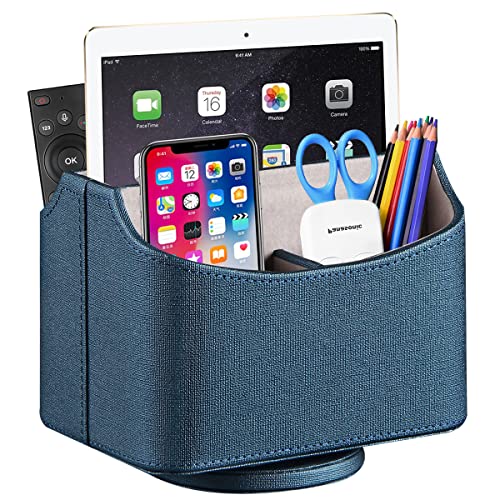
- ✓ Smooth 360° rotation
- ✓ Compact, spacious layout
- ✓ Easy to clean, durable
- ✕ Not huge capacity
- ✕ Limited color options
| Material | MDF with premium faux leather and soft lining |
| Dimensions | 7.48 x 5.51 x 6.29 inches (DxWxH) |
| RotationMechanism | 360° rotatable swivel base for smooth access |
| Capacity | 5-section remote and small item holder (large remote, phones, gaming accessories, etc.) |
| SurfaceFinish | Waterproof surface, easy to clean |
| IntendedUse | Desktop organizer for bedroom/living room as TV nightstand caddy |
You spin the swivel base once and immediately notice the smoothness it promises. The 360° rotation feels satisfyingly quiet, like a tiny desk upgrade you didn’t know you needed.
First unboxing detail that stuck with me: the MDF body with faux leather lining, plus the soft stitching that hints at durability. It sits low, not bulky, so it tucks into a nightstand corner without shouting for attention.
During setup, you’ll appreciate the 7.48 by 5.51 by 6.29-inch footprint—large enough to cradle remotes, phones, and a pen or two, yet compact enough to avoid crowding the surface. The five compartments keep various remotes organized without scrambling for space.
In use, the retractable storage earns its keep. You can slide a streaming device remote, keep a small phone upright, and stash a glasses cleaning cloth in the same loop.
The waterproof surface cleans with a quick wipe, which is a relief after muddy game nights or snack magics gone wrong.
The caddy’s design feels thoughtful for both living room and bedroom setups. It adds a tidy aesthetic to a coffee table or nightstand—subtle, not gimmicky.
If you’re juggling multiple remotes, this becomes the “one-stop” grab-and-go spot you didn’t know you were missing.
My real-world takeaway: it handles daily use with dignity. It won’t replace a full desk organizer, but for a TV nightstand or media corner, it genuinely reduces clutter and friction during ad breaks and marathon sessions.
Bottom line, you’ll likely reach for it as your everyday remote shelter, especially if you value a clean surface and quick access from any direction. It’s a small upgrade that feels like it was designed with real TV-watching hours in mind.
What Makes a Remote Desktop Ideal for Gaming?
The best remote desktop for gaming should offer low latency, high resolution, and reliable connectivity to ensure an optimal gaming experience.
- Low Latency: Low latency is crucial for gaming as it refers to the time taken for data to travel between the server and the client. A remote desktop with minimal latency allows for smoother gameplay, reducing lag that can disrupt the gaming experience and hinder performance in fast-paced games.
- High Resolution and Graphics Quality: The ability to stream high-resolution graphics is essential for immersive gaming. A remote desktop that supports high DPI settings and advanced graphics can deliver stunning visuals, allowing players to appreciate detailed environments and character designs, which is particularly important in visually demanding games.
- Stable and Fast Internet Connection: A strong and consistent internet connection is necessary for a seamless remote gaming experience. Remote desktops that provide features like adaptive bitrate streaming can adjust the quality of the stream based on available bandwidth, helping to maintain a smooth experience even on fluctuating connections.
- Compatibility with Gaming Hardware: The ideal remote desktop should be compatible with a variety of gaming hardware, including graphics cards and peripherals. This ensures that gamers can utilize their setup effectively, taking full advantage of the performance capabilities of their hardware while playing remotely.
- Multi-Device Support: The ability to access the remote desktop on multiple devices, including laptops, tablets, and smartphones, allows for flexibility in gaming. This feature enables gamers to play on the go, ensuring they can enjoy their favorite titles anytime and anywhere, without being tethered to a single machine.
- Security and Privacy Features: Security is paramount when using a remote desktop for gaming, as it often involves sensitive account information and personal data. Look for remote desktops that offer strong encryption and secure access protocols to protect user information from unauthorized access while gaming.
- User-Friendly Interface: A user-friendly interface makes it easier for gamers to navigate and configure settings quickly. An intuitive design can enhance the overall experience by allowing users to focus on gameplay rather than struggling with complicated software functionalities.
How Does Low Latency Impact Gaming Experience?
Low latency is crucial for enhancing the gaming experience, especially when using remote desktop applications.
- Responsive Controls: Low latency ensures that player actions, such as movements or button presses, are registered almost immediately in the game.
- Smooth Gameplay: With reduced latency, the game runs more fluidly, minimizing stutters or lags that can disrupt immersion.
- Competitive Advantage: In competitive gaming scenarios, low latency allows players to react faster than opponents, making it essential for success.
- Improved Visuals: Low latency can enhance the quality of streamed visuals, reducing the chances of artifacts or blurs that can occur during gameplay.
- Better Communication: In multiplayer settings, low latency leads to better synchronization between players, improving coordination and teamwork.
Responsive Controls: When latency is low, there is minimal delay between a player’s input and the game’s response. This responsiveness is particularly important in fast-paced games where quick reflexes can determine the outcome of a match.
Smooth Gameplay: A lower latency contributes to a seamless gaming experience, allowing for smooth transitions and consistent frame rates. This fluidity helps maintain immersion, as players are not jolted out of the experience by lag spikes or interruptions.
Competitive Advantage: In competitive gaming, every millisecond counts. Low latency provides a distinct edge, allowing players to execute strategies and react to opponents quickly, which can be the difference between winning and losing a match.
Improved Visuals: High latency can cause visual artifacts such as ghosting or blurring, particularly in high-action scenes. Low latency enhances the clarity and detail of graphics, allowing players to appreciate the game’s aesthetics without distraction.
Better Communication: Multiplier games require synchronization among players, and low latency ensures that voice chat and game actions are aligned. This synchronization enhances teamwork and strategic planning, making it easier for players to coordinate their efforts in real-time.
Why Is High Bandwidth Essential for Remote Gaming?
High bandwidth is crucial for remote gaming because it directly affects the quality of gameplay and user experience. A high-bandwidth connection ensures that data can be transmitted quickly and efficiently, reducing latency and lag that can severely disrupt gaming.
Key reasons for the emphasis on high bandwidth in remote gaming include:
-
Smooth Gameplay: A higher bandwidth allows for the seamless transfer of graphics and game data, enabling smoother frame rates and reducing stuttering during intense gaming sessions.
-
Real-time Communication: Many games require real-time interaction among players. High bandwidth ensures that voice chat, video feeds, and game updates are synchronized, providing an immersive experience without noticeable delays.
-
High-resolution Streaming: For gamers who prefer streaming at higher resolutions (e.g., 1080p or 4K), a robust bandwidth is necessary to maintain quality without buffering problems. This is particularly important for competitive gaming, where every detail counts.
-
Multi-device Usage: High bandwidth allows multiple devices to connect without degrading the gaming experience. This is beneficial in households where several users may be online simultaneously.
In essence, high bandwidth is a foundational component for any gaming setup to ensure a responsive and enjoyable gaming experience.
What Are the Key Graphics Quality Factors in Remote Desktop Gaming?
The key graphics quality factors in remote desktop gaming include:
- Resolution: The clarity and detail of the image displayed on the screen are determined by resolution. Higher resolutions like 1080p or 4K provide sharper images, which enhance the gaming experience, especially for visually intensive games. However, higher resolutions require more bandwidth and processing power, which can affect performance on lower-end connections.
- Frame Rate: Frame rate, measured in frames per second (FPS), refers to how many individual images are displayed in one second of gameplay. A higher frame rate results in smoother motion and more responsive controls, which are crucial for competitive gaming. However, achieving high frame rates remotely can be challenging due to latency and bandwidth limitations.
- Latency: Latency is the time delay between the input from the player and the corresponding action on-screen. Low latency is essential for an immersive gaming experience, as high latency can lead to lag, making it difficult to control characters or react quickly during gameplay. Remote desktop setups must minimize latency to ensure timely feedback and smooth interaction.
- Compression Quality: When transmitting graphics over a remote desktop connection, data compression is often applied to reduce bandwidth usage. The quality of this compression affects how well the visual details are preserved; high-quality compression maintains sharpness and color accuracy, while poor compression can lead to artifacts and blurriness. Balancing compression and quality is vital for an effective gaming experience.
- Color Depth: Color depth determines the range of colors that can be displayed on the screen, impacting the richness and vibrancy of the graphics. A higher color depth allows for more shades and smoother gradients, which can significantly enhance the visual appeal of games. Remote desktop solutions that support higher color depths contribute to a more immersive atmosphere.
- Network Bandwidth: The amount of available bandwidth directly affects the quality of the gaming experience over remote desktop. Sufficient bandwidth is necessary to transmit high-resolution images and maintain low latency, ensuring that players can enjoy graphics-rich games without interruptions. Inadequate bandwidth can lead to reduced quality and increased lag, compromising gameplay.
What Are the Top Remote Desktop Solutions for Gaming?
The top remote desktop solutions for gaming are:
- Parsec: Parsec is a popular choice among gamers for its low-latency performance and high-quality streaming capabilities.
- Steam Remote Play: This feature allows users to stream and play games from their Steam library on different devices, making it convenient for gamers who want flexibility.
- NVIDIA GameStream: Designed for NVIDIA GPU users, GameStream enables users to stream their games from a PC to a Shield device or other compatible devices with minimal lag.
- Moonlight: Moonlight is an open-source implementation of NVIDIA’s GameStream, allowing users to stream games from an NVIDIA GPU-equipped PC to various devices, including smartphones and tablets.
- TeamViewer: While not specifically designed for gaming, TeamViewer offers remote access capabilities that can be utilized for playing games, though it may not provide the best performance compared to others.
Parsec: Parsec offers a powerful solution for gaming with its focus on low latency and high frame rates, making it ideal for action-packed games. It allows players to connect to their gaming PCs from anywhere and enjoy a seamless experience, with features like co-op multiplayer and screen sharing enhancing social gaming experiences.
Steam Remote Play: This built-in feature of the Steam platform allows users to play their games remotely by streaming from their main gaming PC to other devices, such as laptops or tablets. It supports both local and online multiplayer, allowing friends to join in regardless of their physical location, making it a versatile option for gamers.
NVIDIA GameStream: GameStream is optimized for users with NVIDIA graphics cards, providing high-quality game streaming with very low latency. Users can stream their entire library of games to compatible devices, including the NVIDIA Shield, ensuring a smooth gaming experience even on less powerful hardware.
Moonlight: Moonlight serves as a versatile alternative to GameStream, enabling users to access their NVIDIA-powered gaming rigs from various devices, including smartphones and smart TVs. As an open-source option, it allows for customization and flexibility in how gamers can connect and play from different locations.
TeamViewer: Although primarily a remote desktop application, TeamViewer can facilitate gaming in a pinch, allowing users to connect to their gaming PCs remotely. However, it’s important to note that it may not offer the same performance and experience as dedicated gaming solutions, making it less ideal for serious gaming sessions.
Which Software Provides the Best Performance for Gamers?
- Parsec: Parsec is designed specifically for gamers, offering ultra-low latency performance and high-quality streaming. Its peer-to-peer technology allows players to connect directly to their gaming rig, which minimizes lag and maximizes responsiveness, making it ideal for fast-paced games.
- NVIDIA GeForce NOW: This service utilizes NVIDIA’s powerful cloud infrastructure to stream games with impressive graphics quality. Gamers can access their library of games from various platforms and play them on lower-end devices, benefiting from the high-performance GPUs in the cloud.
- Steam Remote Play: Steam’s Remote Play feature allows users to stream games from their PC to other devices seamlessly. It supports local co-op multiplayer experiences over the internet, enabling friends to join in on the fun without needing to be physically present.
- Moonlight: Moonlight is an open-source implementation of NVIDIA’s GameStream, allowing users to stream games from a compatible PC to various devices. It provides high-performance streaming with customizable settings for resolution and bitrate, making it a versatile option for gamers who want to optimize their experience.
- Microsoft Remote Desktop: Although not primarily designed for gaming, Microsoft Remote Desktop can still deliver satisfactory performance for less demanding games. It allows users to connect to their Windows PC remotely, but latency and performance may vary depending on network conditions.
What Are the Advantages and Disadvantages of Leading Remote Desktop Tools?
| Remote Desktop Tool | Advantages | Disadvantages |
|---|---|---|
| Tool A | High performance for gaming, supports multiple devices, user-friendly interface. Performance: 60 FPS, user rating: 4.5/5. Excels with: Fortnite, Call of Duty. Supported platforms: Windows, macOS, Linux. | Can be expensive, requires stable internet connection, potential latency issues. |
| Tool B | Affordable pricing, easy setup, good for casual gaming. Performance: 30 FPS, user rating: 4/5. Excels with: Among Us, Golf With Your Friends. Supported platforms: Windows, Android. | Limited features, lower performance compared to premium tools, occasional connection drops. |
| Tool C | Excellent security features, cross-platform compatibility, customizable settings. Performance: 40 FPS, user rating: 4.2/5. Excels with: League of Legends, Dota 2. Supported platforms: Windows, macOS, iOS. | Complex setup process, may require technical knowledge, higher learning curve. |
How Can Gamers Enhance Their Remote Desktop Experience?
Gamers looking to enhance their remote desktop experience can focus on several key factors:
- Low Latency Connections: A low latency connection is crucial for gaming as it reduces the delay between your inputs and the game’s response. This can be achieved by choosing remote desktop software that optimizes bandwidth usage and reduces the number of hops between your device and the host machine.
- High Frame Rate Support: The best remote desktop solutions for gaming should support high frame rates to ensure smooth gameplay. Look for applications that can stream at 60fps or higher, as this will make fast-paced games more enjoyable and visually appealing.
- Resolution and Graphics Settings: The ability to adjust resolution and graphics settings can significantly enhance your gaming experience. Remote desktop software that allows you to tweak these settings ensures that you can achieve the best visual quality without compromising performance.
- Game Streaming Optimization: Some remote desktop applications are specifically designed for gaming and include features that prioritize game data over other types of data. This ensures that your gaming sessions are smoother by reducing interruptions from other applications or background processes.
- Hardware Acceleration: Utilizing hardware acceleration can significantly improve performance during gaming sessions. Remote desktop software that leverages the GPU of the host machine can provide a more responsive experience and better graphics than software that only relies on CPU processing.
- Network Quality: A stable and fast internet connection is essential for an optimal remote gaming experience. Gamers should consider using wired connections instead of Wi-Fi when possible and ensure that their network has sufficient bandwidth to handle game streaming without interruptions.
- Customizable Controls: Having customizable controls can enhance gameplay, especially when using a remote desktop. Look for solutions that allow you to map keys or create macros for more efficient gameplay, making it easier to execute complex actions without fumbling with controls.
- Multi-Device Compatibility: The best remote desktop software for gaming should support various devices, allowing you to game on different platforms. This flexibility means you can stream games from your PC to a tablet, smartphone, or even another computer without losing quality.
What Settings Should Be Adjusted for Optimal Gaming Performance?
To achieve optimal gaming performance when using remote desktop software, several settings should be adjusted:
- Resolution: Adjusting the resolution to match your monitor’s native settings can greatly enhance visual clarity and performance. Lowering the resolution can also improve frame rates by reducing the workload on the remote connection.
- Frame Rate: Setting a higher frame rate can lead to smoother gameplay, but it may require a strong internet connection. Finding a balance between a high frame rate and stable connectivity is crucial for an enjoyable gaming experience.
- Bitrate: Optimizing the bitrate can help maintain quality without overloading your bandwidth. A lower bitrate may result in pixelation, while a very high bitrate can cause lag, so it’s essential to find a sweet spot based on your network capabilities.
- Latency Settings: Reducing latency settings can lead to more responsive controls, which is especially important for fast-paced games. Tuning these parameters, if available in your remote desktop software, can significantly enhance your gaming experience.
- Audio Settings: Adjusting audio settings to prioritize performance can minimize lag and improve the overall experience. Disabling unnecessary audio features or lowering audio quality can free up resources for smoother gameplay.
- Graphics Quality: Lowering in-game graphics settings can significantly improve performance by reducing the load on the remote desktop. This includes adjusting texture quality, shadows, and effects to ensure smoother frame rates during gameplay.
- Network Optimization: Utilizing Quality of Service (QoS) settings on your router can prioritize gaming traffic, reducing lag and improving performance during online play. Ensuring that your connection is optimized for gaming can make a significant difference.
- Encoding Settings: Choosing the right encoding settings can impact performance; hardware encoding is typically faster and more efficient than software encoding. Selecting an appropriate codec can help maintain a balance between image quality and performance.
What Common Issues Can Arise with Remote Desktop Gaming and How Can They Be Fixed?
Common issues that can arise with remote desktop gaming include latency, connectivity problems, and resolution discrepancies.
- Latency: High latency can result in a noticeable delay between player actions and game responses, which can severely impact gameplay. To fix this, players can try using a wired internet connection instead of Wi-Fi, or select a remote desktop service that offers low-latency connections optimized for gaming.
- Connectivity Problems: Disruptions in internet connection can lead to disconnections or dropped frames, ruining the gaming experience. Ensuring a stable and reliable internet connection, possibly by upgrading the bandwidth or using a dedicated gaming router, can help mitigate these issues.
- Resolution Discrepancies: Sometimes, the resolution settings on the remote desktop may not match those of the local device, leading to graphical issues or a subpar visual experience. Adjusting the display settings on both the host and client machines to match can resolve these discrepancies, ensuring smoother graphics and a better overall experience.
- Input Lag: Input lag can occur when there is a delay between the player’s commands and the game responding. This can be reduced by optimizing the settings of the remote desktop software, such as enabling hardware acceleration and reducing the quality of the stream to prioritize responsiveness.
- Compatibility Issues: Some games may not run well over remote desktop connections due to limitations in the software. Ensuring that the remote desktop solution chosen supports gaming and checking for any specific settings or configurations that enhance compatibility can help improve performance.